

Intelligent Healthcare Information Integration 11/30/10
Time for the Cheese, Please
“Thought provoking EMR comment. Don’t be sparing us the details of the cool features you’ve seen and which companies are providing the cool features you’ve found … show me the good stuff!”
That’s a compilation of a couple of quotes from John over at EMR and HIPAA after a recent post here where I mentioned I was starting to find some pretty cool pieces and parts amidst the waterfall of EMR/EHR demos I’ve been drenching myself within of late. I promised I would “stop the tease and show the cheese.” (John requested sharp, but it may be more along a Muenster.)
Four upfront caveats:
- I am in no way receiving any remuneration from any of the vendors I will be mentioning.
- I have really enjoyed many, if not most, of the people who have taken their time to show me their solutions. Part of me wishes I didn’t have to end up choosing but one answer / company for our office’s needs.
- While I am certainly keeping self-interest at the fore, I try to consider the needs of my heretofore undigitized colleagues and what my understanding of their needs might include.
- There’s only one of me and I have a day job (well, often a day and night job,) so I wouldn’t even begin to imply I’ve seen all there is to see – but I’m trying!
OK, here we go, and in no particular order of coolness…
Ultimate Usability
Unfortunately, there’s not a system in existence today that has this feature – yet — but the hands-down winner in my book goes to Medicomp’s CliniTalk and its yet-to-be-named Type / Write / Click cousin. Using their medical knowledge engine of “260,000 coded clinical concepts mapped to CPT®, DSM, ICD, LOINC®, RxNorm, SnomedCT®, and other billing codes and clinical reference terminologies,” this middleware allows truly smart data capture, integration, manipulation, and utilization. It’s coming very soon to some pretty good systems which it will help to make great.
I’m so enamored with this functionality that I’m doubtful I’ll be able to choose a new system that doesn’t have it incorporated – or at least one with plans to do so. Seriously, it does for clinical data what I’d always thought a computer should: it adds an intelligence and an level of association-making that a busy clinician really needs while helping to minimize the “Wow, I went to med school to become a data entry clerk for insurance companies” feeling. Unconfirmed, but I hear Sage Intergy will be one of the first to engage this hyper-enhancement.
Eye-Friendliness
This is one of my personal “gotta be there” criteria. It was a huge factor in my love at first site with Bond Clinician, the now life-support-plug-pulled Peak Practice. If my “blink” upon first view of an EMR isn’t one of “OK, that’s kind of pretty,” then I know the demo from there on out will likely only yield ideas for features or functions I might want to see in the other system I do eventually choose.
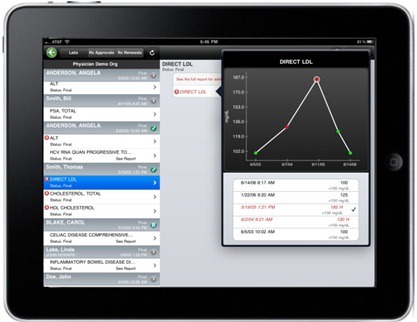
Prettiest faces in this category are all iPad-ian: Quest’s Care360 and ClearPractice’s Nimble. Right up there, too, is Dr. Chrono, but I admit to enjoying the warm feel of faux leather, even if only digital, which Care360 and Nimble use. This familiar view might even assuage some of the anxiety of docs who are still pen-and-paper bound. (I especially like the slightly askew desktop look-and-feel of Care360, perhaps because my desk is usually pretty askew, too.)
Desktop systems could learn a thing or three from these iPad implementations. I mean, really, isn’t there a whole science about HCI (Human-Computer Interaction) and how to make visual content appealing, productive, and efficient? My take: Many EMR vendors could use a few less chief marketing officers and a few more humanistic computer interface designers.
That said, I have seen a couple of desktop systems worth noting. SOAPware’s EMR has come miles from when I first remember its rather basic layout. athenahealth’s athenaClinicals also has evolved nicely since I joined Inga and John Smalling in a group demo about a year ago in an ill-fated jaunt into product demo reviews. (I liked it then; its look and feel is even better now.)
As this is a long, ongoing, often sleep-inducing process, I guess it’ll have to be a “to be continued.” But, before I go, here’s a few I’ll be discussing next time:
- We “get” the “App Me, Baby” idea: SRSsoft’s Hybrid EMR and Medicity’s iNexx.
- EHR vendor team who seems to have the most creative fun: Nuesoft.
- Most exciting new non-EMR EMR: Mitochon Systems mEMR.
- Best digital office preparation tool: Welch Allyn’s EHR Prep-Select.
- The value of views: DIS.
- Using exo-EMR stuff, mostly iPad apps, as really useful patient education and engagement tools: Blausen Medical’s Human Atlas, Pampers’ Hello Baby – Pregnancy Calendar, CHADIS, and Text4baby. (Pseudo exception to caveat #1 above: I also like start-up Health Nuts Media for whom I am the unpaid CMO). Heavy prejudice toward pediatrics, I know, but remember the source here.
- Vendor web sites: what attracts and what repels.
- “The Good, The Bad, and The Ugly” of demos and vendor/client connections.
So, while not meaning to continue the tease as I’m really trying to dole out the requested cheese, I’ll close here with the promise to grate some more fresh Parmesan soon.
From the trenches…
“The early bird may get the worm, but it’s the second mouse that gets the cheese.” – Jeremy Paxman

Dr. Gregg Alexander, a grunt in the trenches pediatrician, directs the “Pediatric Office of the Future” exhibit for the American Academy of Pediatrics and is a member of the Professional Advisory Council for ModernMedicine.com. More of his blather…er, writings…can be found at his blog, practice web site or directly from doc@madisonpediatric.com.








The article about Pediatric Associates in CA has a nugget with a potentially outsized impact: the implication that VFC vaccines…