News 1/6/10

January 5, 2010 News Comments Off on News 1/6/10

HERtalk by Inga
timeline ehr1

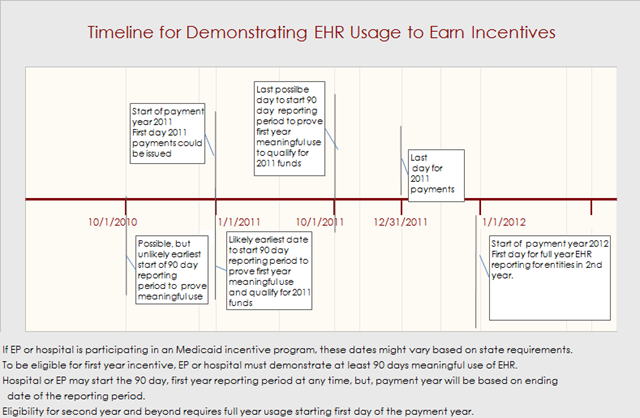
In yesterday’s HIStalk Practice I touched on a few nuggets of information about the latest EHR meaningful use recommendations. I might add it is worth a read because there are some points Mr. H and I haven’t seen covered elsewhere. (And while you are there, sign up for the email updates.) One particularly confusing item relates to the timeline for proving meaningful EHR use in order to earn incentive dollars. I tried to summarize a bit on the timeline for getting money, but because it is particularly confusing, I decided a graphic might help. For those that want to follow along at home, this information is found around pages 23 to 31 in the larger, 557-page document. As I interpret things, to qualify for stimulus money during 2011, a hospital or eligible provider (EP) must demonstrate meaningful use of EHR for “any 90-day period within the first payment year.” The earliest possible start date for that 90 day reporting reporting will likely be January 1, 2011. And, the latest day to start a 90-day reporting period and still qualify for 2011 monies is October 1, 2011. After earning incentive money in the first year, entities will be required to prove meaningful EHR use for a full year, starting on January 1, in order to qualify for second year funds. Thus, if an entity qualified any time during 2011, it would have to continue to prove it used its EHR meaningfully from January 1, 2012 to December 31, 2012 in order to qualify for the 2012 incentive funds. And, if the entity doesn’t try to qualify for the first time until sometime in 2012, then it must prove meaningful use for the full year beginning January 1, 2013, to get the second year funds. And so forth. If someone interpreted things differently (or can explain this better), please advise.

caritas1

athenahealth signs a deal with Caritas Christi Health Care to provide EHR for its 500 employed providers. Caritas, which already uses athenahealth’s RCM service, will also offer athenaclinicals to 1,200 affiliated providers. Caritas also offers its physicians an option for eClinicalworks. Todd Rothenhaus, MD, the CIO for Caritas confirmed with me that Caritas now plan to offer both products.

I was talking EMR with a girlfriend at lunch today (isn’t that what most gal pals do?) and we agreed that we can’t think of any providers that currently enter 80% of their orders themselves. If we thought hard enough we’d probably have come up with a doctor that uses e-prescribing 75% of the time (but we thought of lots of reasons why a patient and provider might prefer the paper prescription.) And, we couldn’t come up with a single small office group that is currently capable of sending patient data electronically to other providers (often times because the receiver can’t accept the data.) The one bright spot is that the recommendations clearly state that “documenting a progress note for each encounter” is not a requirement for proving meaningful use. Otherwise, the mountain is high.

QuadraMed names Thomas J. Dunn senior VP of sales and marketing. Dunn’s a former Eclipsys VP and spent 22 years at SMS/Siemens.

Ridiculously sad, any way you look at it. An unemployed, unmarried 35-year-old mother of nine sues three doctors and two nurses, after she was permanently sterilized against her will. The mom was delivering baby number nine via a planned c-section and and asked for an IUD to be implanted immediately after delivery. Instead, the doctors performed a tubal ligation.

Cerner lands a couple of big deals with Tenet Healthcare and Universal Health Services. Tenet plans to add Cerner applications in 33 new hospitals, bringing the total Tenet/Cerner shops to 47. Universal will take advantage of Cerner’s remote hosting capabilities to implement the product across 24 acute-care hospitals.

trinity1

Trinity Health (MI) buys 1,200 bundled EHR/EPM software licenses from NextGen. Trinity purchased 400 licenses in 2006 for some of its employed providers but now plans to roll the software out to all employed providers in its network.

Happy 2010, by the way. The ever-generous Mr. H gave me a bit of time off during the holidays, but now I am back at it. Mr. H and I have each waded through pieces of the latest meaningful use documents, in hopes of becoming industry experts. Unfortunately, at least in my case, more wading is required. I was hoping there might be some clarification about what exactly a “certified EHR technology” is. Of course “CCHIT” is never mentioned anywhere, even though it seems a given that CCHIT will be a requirement since they are the only certifying body out there. Why can’t the Secretary or the ONC come right out and say it’s CCHIT 200x for now. That way buyers know what is required and vendors know what they need to do if they want to participate.

inga

Send Inga meaningful words.

News 1/05/10

January 4, 2010 News Comments Off on News 1/05/10

From H&R Block: “Re: meaningful use. Heard a peer say the following about ARRA: ‘I didn’t decide to have kids because there was a tax break. I’ll take the one they give, but its not the reason to have kids.’” I’ll say this for the tax code: you don’t need to hire an accountant to help you figure out if you have dependents. On the other hand, after a few hours trying to weed through several hundred pages of the meaningful use guidelines, I’m buying stock in consulting companies. But to H&R Block’s point, I’m not sure how many physicians are going to move to an EMR solely to get some cash from the government. The average physician or office manager will need assistance figuring out the requirements. Even using the most sophisticated software, the requirements are no slam dunk and the upfront costs remain high. If I were a vendor, I would get busy developing an alternate talk-track that encourages EMR adoption for reasons other than just qualifying for ARRA dollars.

wrs

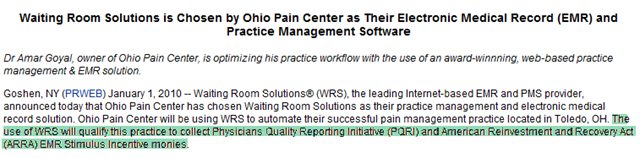
If only it were this easy. EMR vendor Waiting Room Solutions announces that Ohio Pain Center selects its EMR/PM solution, which it claims “will qualify” the practice “to collect PQRI and ARRA EMR Stimulus incentive monies.” I hope someone has told the clinic to check out CCHIT’s website that says Waiting Room Solutions product “has not been tested against the applicable proposed Federal standards in existence on the date of certification for certified EHR technology of its type under the American Recovery and Reinvestment Act of 2009 (ARRA).” Then, perhaps the doctor might want to read through the meaningful use guidelines.

By the way, the latest proposed rules defer the final definition of “certified EHR technology” until ONC’s upcoming interim final rule. The recommendations do indicate that a “certified EHR technology” is a qualified EHR certified as meeting standards defined by the Secretary. Included are a couple of examples of technology that would NOT meet the definition of a certified technology, including a “complete EHR” that hasn’t been “tested and certified in accordance with the certification program established by the National Coordinator, even though it may be claimed that such technology provides the same capabilities as those required by adopted certification criteria.” The key here is we still don’t have a definitive answer as to which “certification programs” (or certifying bodies) are valid. We have to assume CCHIT certification is valid, since it’s really the only player today, but it does leave the door open for other options.  My prediction is that if a product is not CCHIT-certified (probably at least a 2008 level or higher) then it will be tough to qualify for funds.

Last week, Mr. H provided a great overall summary of the ONCHIT preliminary meaningful use definitions (the Excel version is here), and followed up with some overall impressions a couple days later. Much of the 700 pages is redundant, but here are a few additional nuggets of information that focus particularly on eligible professionals (EPs).

Timing of incentive payments

Payment timing varies depending on the EHR incentive program in which the EP is participating (Medicare FFS or Medicaid) or if it is a hospital. Under the Medicare plan, first-year payment qualification requires the EP to meaningfully use an EHR for any continuous 90 days within the payment year. In subsequent years, meaningful use is required for the full payment year. The final dates related to payment timing are not yet defined, but the earliest possible 90-day period could begin July 1, 2010, which is 90 days before the start of the government’s FY 2011 (October 1, 2010). The latest possible date to start the 90-day period and qualify for 2011 payment would be October 1, 2011, which is 90 days before CY 2011. The committee’s recommendation is to set October 1, 2010 as the start date for the initial EHR reporting period, which means qualification (and payment) could come as early as January 1, 2011.

Amount of incentive payments

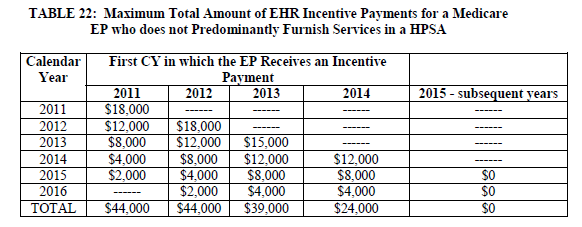
ep incentive

This chart isn’t new, but it does reiterate the need for an EP to reach meaningful use during 2012 if he/she wants to earn the most incentive dollars. Using the proposed timetable listed above, EPs must start the 90-day period proving  Stage 1 meaningful use no later than October 1, 2012.

EPs can opt to be in the Medicaid incentive program, which pays a maximum of $63,750, if at least 30% of his/her patient volume is Medicaid. EPs have the option to make a one-time switch between programs (though the total incentive amount cannot exceed the Medicaid cap). One of the nice things about the Medicaid program (aside that it offers more money) is that you can wait until 2016 to start the certification process and still receive the maximum $63,750.

How to get the money

It’s unlikely HHS will be ready to electronically accept data on clinical quality measures for the 2011 payment year (ironically). Thus, EPs will likely be required to “attest” to its meaningful use of an EHR in order to qualify for funds. By 2012, an EP will electronically submit the summary information on the selected quality measures. Look for compliance reviews to validate provider eligibility and meaningful use assertions.

Assigning money to an employer or other entity

EPs can reassign incentive payments to an employer or entity with which the physician has a valid employment arrangement, though an EP can’t assign payment to more than one employer or entity. Not addressed (that I noticed) was if an EP could assign a portion of the incentive money to a hospital that was not his/her employer. That might be something attractive for hospitals interested in subsidizing upfront EHR costs via Stark legislation.

jesse

The MGMA says that the proposed EHR incentive program rules are too complex and that medical groups will confront significant challenges to meet the program requirements. “Overly burdensome requirements and needlessly complex administration will only discourage physician participation in the program and implementation of EHRs,” says MGMA president and CEO William F. Jesse, MD.  Meanwhile, HIMSS releases a statement saying the proposals offer more that should be applauded than criticized, and provides clarity of what technology functions constitute a qualified electronic health record. I think I am with Jesse on this one.

Nuance Communications releases the results of a 1,000-physician survey about the incentive plan. Apparently the majority of providers think there’s too much emphasis on data capture and quantitative measures rather than the capture of qualitative information that tells each patient’s unique health history (keep in mind that Nuance sells voice dictation products like Dragon Naturally Speaking). Less than 10% of the physicians said they were confident / very confident that the government’s current HIT measures would result in higher quality patient health records.

More negative opinions from physicians on EMR: the 2009 Physician Pulse Report concludes that physicians are increasingly dissatisfied with EMRs, which they find time-consuming and possibly compromising patient safety.

athenahealth signs a deal with Caritas Christi Health Care to provide EHR for its 500 employed providers. Caritas, which already uses athenahealth’s RCM service, will also offer athenaclinicals to 1,200 affiliated providers.

Happy New Year, by the way!

inga

E-mail Inga.

Intelligent Healthcare Information Integration 1/3/10

January 2, 2010 News Comments Off on Intelligent Healthcare Information Integration 1/3/10

Connectiquette

Recently, certain aspects of human interaction related to physicians and/or IT folks inspired some observations on my part (some might call them “rantings.”) As I always hate bemoaning entropy without bespeaking ectropy, I hereby humbly offer up, for your conscientious consideration:

Connectiquette: 11 Rules for an Extropic Future

  1. NEVER text and drive. No, you’re not that talented, you’re not that good of a driver, and it won’t “just take a second.”
  2. Always remember that the live bodies in your presence are more important, and deserve your attention more, than any distant Tweeter, texter, or avatar.
  3. Look at people when you talk with them. While viewing a screen or keyboard, the top of your head is what you present to your patient, client, staff member, mother, etc. Do you really want them to consider your scalp and follicles as the windows to your soul?
  4. Looking at the eyes of someone can always tell you far more than viewing their typographical output.
  5. If new technology causes new workflow patterns to disrupt your interactions with the “organics” around you, get different technology – OR – adapt your workflow to re-enable your connectedness.
  6. Until further notice, carbon / carbon-based interpersonal skills should remain pre-eminent to those required for carbon / silicon-based relationships as well as any carbon / silicon / carbon intercourse, in whatever form.
  7. Courtesy still conveys consideration across any connection. Just because someone can’t lay eyes upon you doesn’t mean they can’t see how inconsiderate you are.
  8. Patients, clients, customers, co-workers, even friends and family — all prefer being treated “Goldenly.” Do you want others to attend to you as you have been attending them?
  9. “Service” and “support,” just like the “care” in “healthcare,” have real definitions. Look them up.
  10. “Electronic” does not equal “better.” Some “old” skills and solutions will long outlast the latest, greatest, “better mousetrap.”
  11. People are still susceptible to faddism; just because something is Web-based doesn’t mean it’s sanctified, certified, or even smart. Discernment and healthy skepticism are more valuable now than ever.

No, I’m not able to cast the first stone, as I have been just as much a digital sinner as anyone. However, I am repentant and searching for a walk nearer to thee, er, I mean, you … and to all the flesh and blood people in my day to day encounters.

Therefore, I promise: next time we’re out to dinner, I’ll keep my snout out of my smartphone and hope you’ll offer me the same Aretha. (R-E-S-P-E-C-T)

From the trenches…

“Respect is love in plain clothes.” – Frankie Byrne

Dr. Gregg Alexander is a grunt-in-the-trenches pediatrician and geek. His personal manifesto home page…er..blog…yeh, that’s it, his blog – and he – can be reached throughhttp://madisonpediatric.com or doc@madisonpediatric.com.

Platinum Sponsors


Gold Sponsors


Subscribe to Updates


Search All HIStalk Sites


Recent Comments

  1. The article about Pediatric Associates in CA has a nugget with a potentially outsized impact: the implication that VFC vaccines…

  2. Re: Walmart Health: Just had a great dental visit this morning, which was preceded by helpful reminders from Epic, and…

  3. NextGen announcement on Rusty makes me wonder why he was asked to leave abruptly. Knowing him, I can think of…

  4. "New Haven, CT-based medical billing and patient communications startup Inbox Health..." What you're literally saying here is that the firm…

  5. RE: Josephine County Public Health department in Oregon administer COVID-19 vaccines to fellow stranded motorists. "Hey, you guys over there…