Home » News » Recent Articles:

News 1/24/13

January 23, 2013 News Comments Off on News 1/24/13

1-23-2013 12-55-20 PM

Medical billing software provider Kareo raises $20.5 million in new funding to launch Kareo Billing Services and expand its sales and marketing efforts. Kareo, which serves over 6,000 customers, doubled its employee base and its revenue in 2012.

1-23-2013 3-45-47 PM

Greenway Medical Technologies unveils an interactive developer portal and extended PrimeSUITE API to facilitate the creation of apps that interoperate with the PrimeSUITE EHR/PM solution.

Grace and Mercy Health Clinic (TX) chooses iPatientCare EHR.

SRS reports a 94 percent increase in revenues from 2011 to 2012 and the addition of 56 new employees, plus an 8,000 square foot expansion to its office space.

1-23-2013 3-35-25 PM

Prince George’s County Health Department (MD)  implements WebChart EHR from Medical Informatics Engineering and NoMoreClipboard PHR across 25 clinics.

1-23-2013 3-29-33 PM

Epocrates says the use of its application has helped clinicians avoid more than 27 million adverse drug events, which represents over 25 percent of all Epocrates drug lookups. Sixty percent of physicians using Epocrates report avoiding at least one adverse drug error every week.

1-23-2013 3-24-56 PM

National HIT Coordinator Farzad Mostashari, MD highlights some of ONC’s 2012 achievements, including:

  • 64 percent of EPs registered for the MU program
  • 33 percent of EPs received MU payments
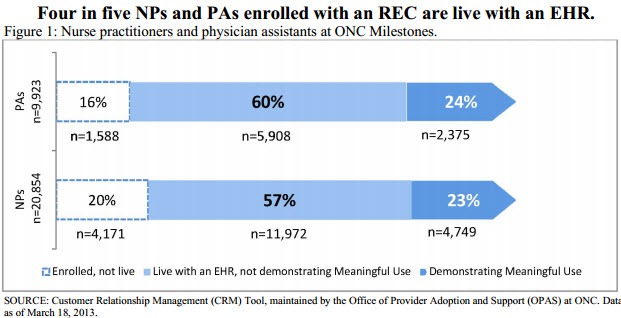
  • 132,842 primary care providers in over 31,000 practices received EHR assistance from RECs
  • Over 100,000 of the REC-assisted EPs are now live on an EHR and nearly 40,000 have achieved MU
  • Over 80 percent of all FQHCs were assisted by RECs.

Inga large

E-mail Inga.

News 1/22/13

January 21, 2013 News 1 Comment

1-21-2013 1-47-13 PM

A growing number of pharmaceutical companies and other businesses are taking advantage of advertising opportunities within cloud-based EMRs. EMRs such as Practice Fusion generate ads based on keywords and allow advertisers to message directly to doctors at the point of care. More than 85 percent of the major pharmaceutical companies currently run ads within Practice Fusion.

athenahealth announces it will offer an anesthesia-specific billing solution for hospitals and independent practices.  MedOasis will provide the capabilities for anesthesia coding, charge-entry, contract management, and compliance.

1-21-2013 2-41-02 PM

1-21-2013 2-40-00 PM

EMR/PM provider iSALUS Healthcare and RCM firm CIPROMS partner to integrate and co-promote their services to physicians.

A study published in JAMA Internal Medicine suggests e-visits may be just as effective as in-person office visits for uncomplicated ailments such as sinus infections and UTIs. Researchers also found patients receiving online care were prescribed more antibiotics, perhaps because providers used more conservative treatments when unable to see patients in person. Even with additional prescriptions, e-visit care costs for UTI patients were less than in-person visits ($74 versus $93 a visit.)

Neighborhood Health Plan and Partners Health (MA) will provide $4.25 million in grants to 49 community health centers to expand HIT systems, train on Meaningful Use and medical coding, and train and build capacity for performance improvement.

Last week HHS Secretary Kathleen Sebelius announced the final omnibus privacy and security rule that expands HIPAA’s reach to business associates, increases penalties to $1.5 million per violation, and clarifies breach notification requirements. One provision that particularly impacts practices is the requirement for providers to give patients their medical information in electronic form if requested, assuming the data is stored electronically. Another provision that could require vendors to modify their software and practices to change workflows allows cash-paying patients to instruct providers not to share treatment information with their insurance company.

AMA News reviews the new CPT codes for transitional care management and complex chronic care coordination, including advice on when to use which code. The new codes went into effect January 1 and allows practices to bill for coordinating the care of patients when discharged from a hospital or with multiple chronic conditions.

Last week the HIStalk Practice Advisory Panel provided some good insight into the resources their practices use when comparing HIT vendor and products. A few of my favorite comments:

Lately we’ve awarded three contracts without a formal RFP or competitive vendor selection process. Unfortunately, that approach has been both expensive and has resulted in us owning products or buying consulting services that have failed to meet the functionality or quality our users desire. Hopefully we’ll learn a lesson soon.

When our administrators looked for an EHR, they simply looked at the market leader in our niche market, got a one-hour demo, and chose it. Turns out that’s not a good method.

Google and Web research. EMRConsultant.com. Personal recommendations from colleagues. Demos, demos, demos.  Getting access to a test site for extended, unrestricted hands-on experience seems to be the most helpful.

1-21-2013 4-31-12 PM

Greenway Medical Technologies, Inc., announces that Greenway PrimeSUITE 2014 (17.0) is compliant with the ONC 2014 Edition criteria and was CCHIT-certified as an EHR Module.

Inga large

E-mail Inga.


.

DOCtalk by Dr. Gregg 1/18/13

January 18, 2013 News 1 Comment

Another Hectic Day in Healthcare, 2063

Health Affairs’ January 2013 issue has an article entitled “Primary Care Physician Shortages Could Be Eliminated Through Use Of Teams, Nonphysicians, And Electronic Communication.” Using simulation analyses, the authors argue that the looming primary care physician shortage predicted by the Association of American Medical Colleges is inaccurate, or at least avoidable. (Shortages of 45,000 to as high as 200,000 PCPs have been projected.)

Their new assumptions on changing demographics and alternative methods of care may make sense, but I wanted to sidestep suppositions. Thus, I went straight to the most reliable source I know: my dear old spirit guide, Madame Blavatsky. She immediately channeled one of the finest techno-futurists to ever pass over, Arthur C. Clarke! Though the spirit ethers wouldn’t allow a direct connection – something to do with a recent “Clarke-Asimov Spirit Treaty” – she was allowed to pass along a typed transcript of a short story written by Clarke about a day in the life of a primary care doc in the year 2063.

If “Ego” has nailed yet another future science prediction, it may bode well for the attractiveness of primary care to the next generation!

I relay the tale to you exactly as I received it:

—————————————————————————

I step from the autoshower, clean and fresh. It never ceases to amaze me just how perfectly the sensors know what water temperature I prefer each day. It’s never exactly the same day to day, according to the home central water readouts, but it always feels just perfect.


After daily ablutions are complete, I step into my cozy office just off the master bedroom to begin patient care. Today it’ll all be from my home, which I enjoy, though I admit that the live visits with patients in their homes are my favorite. Still, much of the work is so integrated and the reality of the virtual is so nearly real, it’s sometimes hard to know where live care and care-at-a-distance diverge. (The old term “telehealth” isn’t really used much anymore because it’s all so integrated.) Still, there’s something that’s just more deeply satisfying with live, in-person visits.


As I begin another day of virtual office work, I think of the old days when I used to actually have to log in using passwords and iris scans. The DNA sensors (which have since made those old, cumbersome, and not infallible security measures obsolete) are so seamless that I often forget that there ever was a security issue. Not that DNA sensors didn’t have their own security flaws in the early days, with hackers replicating DNA sequences as easily as they used to hack Java. But since the upgrade to DNA/RNA cross matching and the SensoCheck verification response system, there hasn’t been one successful breach in over a decade.


Before I set to business, I think of my own daily health SensoScan and, almost immediately, it completes before I finish settling into my chair. (I’ve always loved how SensoTools can activate with just a thought.) No major disruptions in vitals, heartscan, brainscan, organ function, or antibodies. Circulatory status fine, chemistries stable, and respiratory function remarkably unremarkable. Nucleic sequence mutations remain within acceptable limits. I do note one slight variation: some notable decrease in pigment in new hair growth. But, when you’re 79 – and since I opted out of the regeneration recoding – you gotta expect a little of that. I actually prefer the little bit of gray that now highlights my head and mutton chops. [A nod to his friend, Asimov? – Dr. Gregg]

As I turn my eyes toward the SensoScreen zone, the space above my desk becomes awash with 3D imagery of patients and their data updates. All is “green-and-go” on my patient panel except for the always curious Mrs. Sturnburner. She questions whether her SensoReads are accurate – again – because they don’t show any notable problems –again – despite her ongoing assertion that her bowels aren’t working as they should – again. I direct a personal note to her that these slight variations in intestinal consistency are a normal fluctuation and remind her – yet again – that dietary fluctuations cause routine changes in bowel output and peristaltic activity. At 124, she has had a hard time believing anything the SensoReads tell her. (Understandable, since she spent so much of life distrusting the frequently flawed data from the pre-SensoTools days.)


After scanning, I verify that all of the patient data, reports, notifications, and current SensoFeeds have been successfully transmitted via the SensoHIE. (How we ever survived in the days before health data was auto-transmitted and collated is beyond me.) The SensoHIESync shows full and intact data integrity with all communication lines green. Consultant feeds are clean and SensoPharm shows no outstanding needs or conflicts.


Speaking of SensoPharm conflicts, it seems sort of antiquated that there’s even a “Conflicts” alert anymore since all pharmaceuticals are either autoinduced, genomic redactions, or constructed on demand via in-home Senso3DPrinters. None of these can ever be initiated with any possible therapeutic conflict potential. Still, the “Conflicts” alert lingers as a holdover from the days before full Senso-integration. Sorta quaint, really.


All of a sudden, up pops a request from Jemma Thompson. It seems her five year old has swallowed one of the pieces from his recent Christmas present, the new “Al-Zirc Legos Master Planet Builder” set. The new alumina-zirconia nanocomposite-stabilized pieces don’t pick up well on SensoScan, so she’s a little freaked out even though the child seems fine. I dispatch one of the new VirtGo Hoverbots to her home; it arrives within minutes. Its robotic 3D ultrasound arm quickly locates the small round toy floating safely within the child’s gastric juices. I reassure Jemma that all will be fine and instruct her on how to adjust the SensoStool settings on her toilet to make certain that the toy’s passage is autorecorded. She smiles warmly, though I’m not sure if it’s for me or for the SensoStool scanner that keeps her at a comfortable distance from any manual fecal examination.


With the Hoverbot floating its way out of Ms. Thompson’s door, I relax in my chair and notice the time. I can barely believe that it’s nearly noon! The hour has just whizzed by. I think to myself that I’ll probably need to schedule an old-fashioned, real person, hands-on massage after such a hectic day.


Hopefully tomorrow will be less stressful.

—————————————————————————

From the trenches…

“All that we are is the result of what we have thought. The mind is everything. What we think, we become.” – Gautama Siddharta

gregg alexander

Dr. Gregg Alexander, a grunt in the trenches pediatrician at Madison Pediatrics, is Chief Medical Officer for Health Nuts Media, an HIT and marketing consultant, and sits on the board of directors of the Ohio Health Information Partnership (OHIP).


News 1/17/13

January 16, 2013 News Comments Off on News 1/17/13

1-16-2013 11-17-18 AM

A study published in Annals of Family Medicine finds that EHR adoption by family physicians has doubled since 2005 and will exceed 80 percent by the end of 2013. Researchers also found family physician adoption rates were higher than those of other office-based physicians as a group, but say the reason is “unknown.” My theories: EHRs are better suited to the workflow of FPs; FPs are more motivated than higher-paid specialists to adopt EHRs and take advantage of MU incentives; and more low-cost EHR options exist for primary care physicians than specialists. Any other theories?

White Plume Technologies will offer its charge capture and coding solutions customers Wellcentive’s AccelaPQRS, a registry-based alternative to claims-based PQRS reporting.

1-16-2013 11-50-53 AM

GE Centricity resellers Alliance Healthcare Solutions and Final Support merge to form Quatris Health and become the largest VAR for GE Centricity practice solutions.

1-16-2013 2-59-54 PM

ACPE finds that only 12 percent of physicians find online physician ratings helpful. More than a quarter say the rating sites are a nuisance and over half don’t believe their patients have used one. However, 81 percent of the physicians who check their profiles think the ratings are at least partially accurate.

AMA submits comments to ONC urging that Meaningful Use Stages 1 and 2 be evaluated before committing to a Stage 3. It says its members most often express five concerns: (a) passing requires a 100 percent score; (b) the core measures are inflexible with regard to practice patterns and specialties; (c) the program needs to be independently evaluated; (d) EHR certification needs to place more emphasis on software usability; and (e) healthcare IT infrastructure barriers prevent data sharing. AMA wants three years between stages to give EHR vendors time to prepare – one year for making the rules, one for product development, and one for implementation.

1-16-2013 2-16-24 PM

The AAFP also submits comments that call for a delay of Stage 3 until at least 2017 and an elimination of all penalty provisions. It says HHS should (a) focus on problems that require coordination rather than wasting resources on criteria such as CPOE, demographics, lab results, and counting and verifying electronic prescriptions; (b) promote simplicity over complexity; and (c) require the implementation of measures that have broad, clinically-proven impact rather than experimental measures that may not be mature enough for the MU program.

Inga large

E-mail Inga.

News 1/15/13

January 14, 2013 News 1 Comment

1-14-2013 3-22-51 PM

From Maple Man: “Re: EHR petition. Dr. William Zurhellen is a solo pediatrician who believes EHR certification should focus on improving care and that anything else is a waste of time. He has now started a petition of the Obama administration to change the direction of EHR technology so it is focused on healthcare outcomes and controlling costs.” The petition notes that current technology is designed to enhance payment rather than clinical outcomes, adding, “Elements needed are episodes of care, continuous quality improvement, statements of relative outcome, and full integration with practice management tools.” The petition will be delivered to the White House for review if it gets 25,000 signatures, so exercise your First Amendment right if you are inclined.

1-14-2013 11-57-30 AM

Speaking of free speech, SRS CEO Evan Steele posts a note to National Coordinator Farzad Mostashari expressing concerns about the future of the EHR incentive program, which he believes is “plagued by rampant dissatisfaction among physicians.” Steele believes the program is too complex and may fail unless it is simplified to focus on e-prescribing, quality reporting, and interoperability. I am not disagreeing, but I wonder if provider perceptions would improve  if the industry offered more user-friendly technologies that handled more of the minutiae in the background.

1-14-2013 3-20-20 PM

The FACES Foundation, which provides cleft lip/palate care for indigent and medically isolated patients, buys SOAPware EHR .

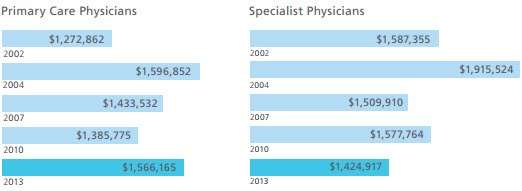
Almost 21 percent of primary care physicians report that their personal income fell more than 10 percent in 2012, while an additional 16 percent say their income dropped 10 percent or less. Almost 40 percent of primary care physicians and most pediatricians reported incomes of less than $150,000 a year.

1-14-2013 12-12-32 PM

Rep. Nydia Velazquez (D-NY) introduces a bill that would provide SBA loan guarantees of up to $350,000 for single practitioners and $2 million for group practices for the purchase EHRs and other clinical HIT systems.

HIT lawyer Howard Burde offers advice for physicians contracting with a cloud-based EHR vendor, including recommendations that the contract spell out when and how a practice has access to data; how security is assured; how often backups are made and where they’re stored; how frequently services are upgraded; and how often the system is unavailable.

1-14-2013 1-04-46 PM

Lincoln Orthopaedic Center (NE) selects the SRS EHR, PACS, and Patient Portal for its 14 providers.

CMS publishes an EHR MU tip sheet to help specialty providers meet MU requirements, including clarification on required core, menu, and clinical quality measures; using data entered by other providers; defining office visits; and applying for hardship exemptions.

Analysis published in Health Affairs suggests that the projected primary care physician shortage could be eliminated if small practices shifted as little as 20 percent of their patients to non-physician providers and used an EHR. The authors’ conclusions are in part based on the assumption that greater use of EHRs improves a practice’s efficiency and allows more patient to be seen. Obviously not all providers concur with that assumption.

Inga large

E-mail Inga.

Platinum Sponsors


Gold Sponsors


Subscribe to Updates


Search All HIStalk Sites


Recent Comments

  1. The article about Pediatric Associates in CA has a nugget with a potentially outsized impact: the implication that VFC vaccines…

  2. Re: Walmart Health: Just had a great dental visit this morning, which was preceded by helpful reminders from Epic, and…

  3. NextGen announcement on Rusty makes me wonder why he was asked to leave abruptly. Knowing him, I can think of…

  4. "New Haven, CT-based medical billing and patient communications startup Inbox Health..." What you're literally saying here is that the firm…

  5. RE: Josephine County Public Health department in Oregon administer COVID-19 vaccines to fellow stranded motorists. "Hey, you guys over there…