Home » News » Recent Articles:

DOCtalk by Dr. Gregg 12/28/12

December 28, 2012 News Comments Off on DOCtalk by Dr. Gregg 12/28/12

An EHR in Every Pot?

As 2012 — the second full year of Meaningful Use — winds down, perhaps a little reflection on the whole drive toward digital data from the “grunt in the trenches” perspective is in order. (Well, if not ordered, at least I’ll try to keep from being disordered.)

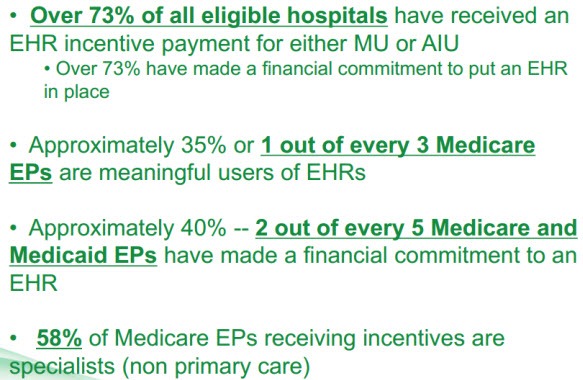
If you saw any of or heard much about the recent ONC 2012 Annual Cheerfest … er … Meeting, you know that lots of people across all parts of healthcare’s realm have been busily adopting and implementing and cashing in MU checks. Don’t get me wrong. I’m a fan. I’m not knocking the whole hoopla that ONC orchestrated to showcase the progress that MU incentives have helped drive forward. The meeting was a bit cheerleader-ish, sure, but with so many folks questioning what has come from this enormous investiture, it was probably warranted as a “team” rally, as a way to spotlight what has come forth from all the HITECH seeds that have been sown.

Healthcare appears to have crossed the tipping point for digitization. And, there is a fair case to be made that MU incentivization was one of the prime successful drivers pushing us over that peak. Lots of people – from providers to vendors to political appointees – are cheering all the way to the literal or figurative bank about this fact.

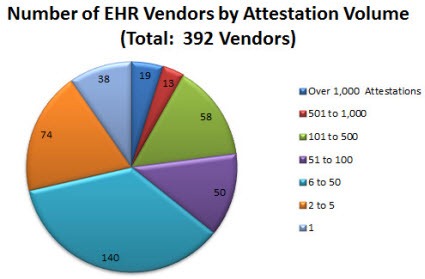
12-28-2012 7-39-05 PM

However, not everyone is rooting “Rah, Rah” for EHRs, especially not in the small grunt trenches. Recent numbers have shown that the drive toward digital has been prompting a provider exodus from private and smaller independent practices. Regulations and costs, many related to HIT adoption, are being blamed as primary causes for the 57 percent to 39 percent decline in the number of docs in private practice over the past 12 years.

Of course, there are still a number of providers out there who are refusing to let go of pen and paper. Many of them are nearing the end of their careers and the daunting challenge of transitioning from decades of ingrained workflow habits just doesn’t make sense. (Personally, I get that. Those folks should be allowed to finish their careers in pressed wood pulp peace.)

But there is also a reversal of sentiments for some as regards EHRs and MU incentivization. Providers may be buying EHR systems, but driving through to MU is another matter. The American Academy of Family Physicians (AAFP) has noted that while attestation for MU has risen dramatically this year, the gap between registration and attestation is significant. By October 2012, of the 225,000 Medicare EPs registered, only some 88,000 had pushed through to attestation. Jason Mitchell, MD, assistant director of the Center for Health IT at the AAFP, says that many family docs have stopped trying to obtain MU incentives “because the hoops they have to jump through are so onerous."

And then, there’s the recent tale I read of a group practice that had gone fully digital only to drop the stylus and revert to pen and paper. They felt their professional satisfaction and provider-patient relationships were far better off without a computer intermediary. (I’ve searched high and low to find the link to this recent story, but have lost it – sorry. If you know of it, I’d love to have you forward the URL.)

While a short term “we can practice better and feel better about how we practice” sentiment can be attained by staying with or reverting to paper and pen, I think this is short-sighted and selfish. Mountains of paper, with often illegible data, obstruct the advance of healthcare knowledge and insights. Going digital is essential if we, as a health system whole, want to improve the healthcare system for all.

Many of you who read the HIStalk family of web pages are more “big guy” oriented as vendors, medical institution affiliates, or larger group practice members. Sometimes when I read HIT blogs and news, there almost appears to be a single-mindedness about EHRs and MU attainment that encompasses large- and medium-sized provider groups. The little guys don’t seem to be nearly so well considered. Maybe that’s because it’s easier to consider the larger organizations because, overall, that space is easier to address. Going digital is never easy, but it is definitely more doable en masse.

But remember, there’s still a large portion of healthcare being delivered by small, independent providers, and these folks are finding the EHR parade and MU bandwagon difficult to join. The stressors are driving some away from independence, some away from digital, and some — though they are going digital — are forgoing the incentives to MU.

Personally, I don’t want to see all the small practices subsumed by ACOs or every provider owned by a health system conglomerate. I believe there’s value in the variation and that some care is better handled outside of a corporate structure. And I believe all of us will be best served once everyone can truly share health data. That is when there will be true meaningful use, incentivized or not.

But the little guys need better solutions, solutions that fit their situations and that aren’t just trimmed down versions or barebones models of systems designed for bigger players. I’m not just talking HIT solutions. They need easier entry to the EHR world and fewer hoops through which they must jump.

Will there eventually be an EHR in every pot, so to speak? Yes. Not yet, but it will happen. I just hope it happens before too much backlash and too much frustration drives to extinction the small, independent provider practices. The care they provide is valuable to many, many folks who enjoy the more intimate setting and services they provide.

From the trenches…

“…Put the proverbial ‘chicken in every pot.’ And a car in every backyard, to boot.” – Republican National Committee advertisement, 1928 (Herbert Hoover never actually made such a promise, though he often receives attribution.)

Dr. Gregg Alexander, a grunt in the trenches pediatrician at Madison Pediatrics, is Chief Medical Officer for Health Nuts Media, an HIT and marketing consultant, and sits on the board of directors of the Ohio Health Information Partnership (OHIP).

News 12/27/12

December 26, 2012 News Comments Off on News 12/27/12

12-26-2012 2-50-51 PM

A third of providers say they have experienced varying levels of payment delays during the HIPAA 5010 transition, with clearinghouses causing 52 percent of those delays. Navicure is named Best in KLAS as the top claims and clearinghouse provider, followed closely by ZirMed and Office Ally.

ZirMed updates its PQRS Suggested Measures tool for 2013.

12-26-2012 3-43-45 PM

PM/EMR provider Henry Schein MicroMD will integrate the eSelectPlus payments gateway from Moneris Solutions into the MicroMD PM software.

Aprima Medical Software completes its first conversions of Allscripts MyWay customers to Aprima as part of its Aprima Rescue Plan. One of the first was Crystal Community ENT (FL), which had been on Allscripts MyWay for less than two months when it received notice that the product would not be enhanced to meet MU and ICD-10 requirements.

The Wall Street Journal reports that more providers are adopting telehealth technology as more insurers and employers agree to pay for virtual doctor visits. Virtual consults typically cost $40 to $45, which is far less than a visit to the ER or urgent care center or a face-to-face appointment with a physician.

A study finds that the perceived lack of human and financial resources is the biggest barrier to the adoption of automated reminder and recall systems for upcoming immunizations. Providers also lack confidence in the accuracy of patient immunization records, given limited data sharing between multiple providers. Additional barriers to adoption include changes to staff workflow, lack of appropriate electronic patient tracking functionalities, and uncertainty regarding the success of automated reminders.

I suspect that many readers are enjoying an extended holiday week. I am – alas – actually working a bit, though I rather be on a beach somewhere or maybe skiing down a mountain. If you are one of the lucky few keeping the HIT wheels churning this week, feel free to drop me an e-mail and tell me what goodies Santa left in your stocking.

Inga large

E-mail Inga.

News 12/20/12

December 19, 2012 News Comments Off on News 12/20/12

From Charlie Watts: “Re: surveys. It’s interesting that you are concerned with Universal Survey’s funding source, but not KLAS’s. Vendors fund a significant part of KLAS’s operations and larger vendors with many products pay the lion’s share of KLAS’s revenues from vendors versus the smaller companies. Of even greater concern is that KLAS has assumed the responsibility of defining an EHR—with total disregard for the government’s definition of an EHR. KLAS’s list of rated vendors contains only the largest vendors. Smaller vendors, regardless of quality, are relegated to the footnote section of the rankings. KLAS footnotes several products as ‘component’ even though they are certified as a complete EHR and have successful attesters. If KLAS accurately categorized these EHRs, the rankings would be different, which would have certainly upset some of their big revenue sources. One would be led to believe that KLAS is not an independent research company and is influenced by the name brand vendors that represent the lion’s share of their income they derive from vendors.” I support transparency and I think most of these vendor-ranking surveys could benefit from better disclosure of funding sources and survey methods. Mr. H offered some great commentary on the subject a couple of years ago and came to this conclusion:

The evils of KLAS are really a reflection of the evils of its provider and vendor members. Vendors try to game the system without getting caught, while providers unwisely overweight the value of KLAS in making their IT decisions. All of that is highly profitable to KLAS, but more power to them for creating a niche that still has minimal competition and strong business after all these years.

12-19-2012 11-03-53 AM

Meadowlands Hospital Medical Center (NJ) chooses eClinicalWorks Care Coordination Medical Record and EHR solutions to advance its ACO objectives. eClinicalWorks also announces that Urban Health Plan (NY) will add eCW’s Care Coordination Medical Record for its ACO-related initiatives.

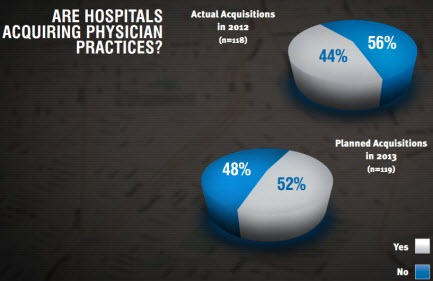
Sixty-eight percent of surgeons are employed by a hospital or large group practice instead of working in their own practices. Between 2006 and 2011, the number of full-time hospital-employed surgeons jumped 32 percent.

12-19-2012 11-18-17 AM

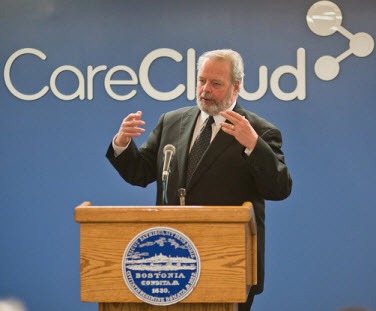
CareCloud appoints John J. Walsh (Constant Contact, Inc.) chief technology officer.

Medinova Physicians (NY) implements the PatientPoint Care Coordination platform to address core principals of the PCMH model for NCQA certification.

12-18-2012 3-42-09 PM

Trustees of St. John’s Medical Center (WY) decide to spend $240,000 to buy eClinicalWorks as a replacement for McKesson Practice Partner, which it has been running for five years. They say Practice Partner is not user friendly and makes it difficult to document office visits.

If you are a provider or work in the ambulatory care setting and interested in participating in our HIStalk Practice Advisory Panel once a month or so, drop me a note. We will be sending out a new survey in the next few days and welcome a broad range of insights and opinions.

The end of the year always tends to be a slow period for news, so we will likely forego a post on the 25th. Of course the real reason I’m taking the day off is that I need time for last-minute shopping, feverish gift wrapping,  and prepping for a feast or two. Best wishes to all!

santa inga small

E-mail Inga.

News 12/18/12

December 17, 2012 News 4 Comments

12-17-2012 10-02-21 AM

Epic wins big in the Physician Practice Solutions categories in the 2012 Best in KLAS Awards, taking the top spot in the “Over 75 physicians” categories for both EMR and PM and for the “11-75 physicians” EMR category. AthenaClinicals was the leader in the 1-10 physician EMR segment and for PM in both the 11-75 and 1-10 physicians segments. Other observations: a) Allscripts, McKesson, Vitera, and GE populated the bottom spots on the EMR rankings; b) Greenway and eClinicalworks had solid EMR rankings; c) NextGen, GE, Greenway, and e-MDs scored well in the PM segments; and d) Vitera, Allscripts, eClinicalWorks, and McKesson had the lowest spots in the PM categories.

12-17-2012 12-37-15 PM

A reader forwarded me another user satisfaction survey produced by University Survey. The report looked at ambulatory EMRs and included responses from 1,051 specialists (ophthalmologists, dermatologists, and cardiologists). The top-rated products were SRS and eClinicalWorks, while Allscripts and Greenway were ranked last. Specialists have different EMR requirements and their product preferences aren’t necessarily the same as primary care providers, but I am a little suspect of the quality of data, primarily because (a) University Survey would not respond to my direct question about whether or not a vendor or some other entity paid for the survey to be conducted, and (b) the report offers no details on the survey methodology. My opinion: KLAS, University Survey, Black Book, and similar surveys provide interesting data points, but should never be the sole consideration when making a buying decision.

The world seems like a troubling place at the moment, making it a perfect time to add a bit of levity to your day. Take a minute to read Joel Diamond’s Year in Review post, which provides a tongue-in-cheek look at the most compelling HIT news events for 2012.

12-17-2012 1-25-00 PM

American Family Care, which has 34 locations across Alabama, Tennessee, and Georgia, completes its implementation of DocuTAP’s EMR and PM products.

12-17-2012 1-22-57 PM

The 370-physician Kelsey-Seybold Clinic (TX) becomes the first healthcare organization to earn NCQA accreditation as an ACO.

Vitera Healthcare announces the general release of Live Chat, which provides customers with immediate online access to Vitera customer support.

histalk practice new

Assuming you are reading this post on a desktop or laptop and not a mobile device, you have likely noticed our brand new HIStalk Practice Web page format and logo. We refreshed HIStalk Mobile (now known as HIStalk Connect) a couple of weeks ago and HIStalk’s transition is coming soon. A big thank you to the folks at Dodge Communications for the providing us with the snappy logo designs. We really hope you like the new look.

santa inga small

E-mail Inga.

Joel Diamond: The Year in Review

December 16, 2012 News 3 Comments

It’s that time of year. Every legitimate news outlet airs or publishes its “Top Stories of the Year” piece. Since I’ve yet to see a good one for healthcare IT, I thought that this would be the time to start a new tradition here at HIStalk. So without further ado, I bring you the six most compelling news events as related to our industry in 2012.


US Doctors Accept Payments to Use Electronic Records

In one of the top stories this year, a widespread bribery scandal continues to unfold. It is now evident that millions of dollars have been slipped into the pockets of soiled white coats, outdated sport jackets, and questionably needed scrubs throughout the nation. 

Investigators confirm that these payments were made to a group calling themselves the “Eligible Providers,” apparently putting the lives of patients lives at risk by coercing doctors to use computers in their practices. 

One of the ringleaders in the bribery scandal, Farzad “The Enforcer” Mostashari, was heard in a federal wiretap saying, “Yeah, this year they should accept our generous offer, if not they will be payin’ us… big time. After that, we start breakin’ kneecaps.”

Justice Department officials have estimated that upwards of 45 percent of US physicians have heroically rejected this extortion, but fear that those numbers may be dwindling.


Meaningful Use

In a shocking blow to physician autonomy, new draconian regulations threaten to bring an otherwise efficient healthcare system to its knees. One of the more controversial requirements includes forcing doctors to record rarely-used data such as patient vital signs, allergies, and medications.  An unnamed spokesperson for the AMA is quoted as saying, “This kind of needless oversight is unconscionable. What’s next? Making us keep a list of current medical problems?“  

Jack Meihoff, chairman of the Center to Promote Continued Medical Errors, says the legislation is illegal. He adds, “If the Founding Fathers intended doctors to e-prescribe, then why did they sign the Constitution with a feather pen?” 

It appears that the new rules don’t stop here. Rumors are spreading in Washington that new legislation might require providers to care for patients with chronic diseases using well-established guidelines.


ICD-10 Delayed

ICD-10 was endorsed by the Forty-Third World Health Assembly in May 1990 and came into use in WHO Member States in 1994. It is therefore not surprising that implementation has been further postponed to 2014. 

Using an odd analogy, Ben Dover, spokesman for the Central Association of Hospital Organizations Not Enough Standards (CAHONES), says, “After 22 years, it’s kinda like a 400-pound guy losing 30 pounds after getting a lap band. Who’s gonna notice?”


Elected Officials Agree — US Healthcare is Expensive, But You Get What You Pay For

The election year was marked by misstatements, exaggerations, and outright lies on both sides. But here’s one thing that Republicans and Democrats have no disagreement about. Our growing fiscal crises need not be concerned with healthcare because our system has its priorities in order. 

For instance, amongst OECD member countries, the US again ranks among the worst for strokes, heart attacks and infant mortality. But this year, it’s #1 in the number of MRI machines.


Black Friday Shopping Frenzy Leaves Dozens Dead

After sleeping out all night in the frigid Wisconsin air, hundreds of frenzied CIOs rushed the doors at the Madison EpicMart after Thanksgiving, hoping to be lucky enough land a new EHR this holiday season. Several people were trampled to death. 

“I don’t understand it,” said one shaken onlooker. “You can buy a system for millions of dollars cheaper. Why are these people doing this? I’m just trying to score a good deal on a flat screen.”

Meanwhile, Costco owners express satisfaction with the “steady but well-behaved shoppers” in the eClinicalWorks aisle.


ACOs Top CEO Wish Lists

A nationwide poll of top hospital executives shows ACOs edging out The Amazing Motorized Web Shooting Spider-Man Figure and the LEGO Hobbit Game as this season’s most sought-after gift. Retailers are bracing for heavy demand in the coming year as well. “We can’t seem to keep these ACOs on the shelf,” says one distributor. 

More concerning is that most new owners don’t realize the potential havoc their new purchase might cause once they get it home. A seasoned seller warns, “Don’t get any water on it, and never, never ever feed it after midnight.”

Industry insiders were stunned at the remarkable interest in ACOs. Many predicted that Big Data and the Furby would be the top sellers this year.

Seriously, I wish each and every one of you a very happy, peaceful, and most importantly healthy New Year.

Joel Diamond, MD is chief medical officer at dbMotion, adjunct associate professor at the Department of Biomedical Informatics at the University of Pittsburgh, and a practicing physician at UPMC and of the Handelsman Family Practice in Pittsburgh, PA.

Platinum Sponsors


Gold Sponsors


Subscribe to Updates


Search All HIStalk Sites


Recent Comments

  1. The article about Pediatric Associates in CA has a nugget with a potentially outsized impact: the implication that VFC vaccines…

  2. Re: Walmart Health: Just had a great dental visit this morning, which was preceded by helpful reminders from Epic, and…

  3. NextGen announcement on Rusty makes me wonder why he was asked to leave abruptly. Knowing him, I can think of…

  4. "New Haven, CT-based medical billing and patient communications startup Inbox Health..." What you're literally saying here is that the firm…

  5. RE: Josephine County Public Health department in Oregon administer COVID-19 vaccines to fellow stranded motorists. "Hey, you guys over there…