Home » News » Recent Articles:

DOCtalk by Dr. Gregg 9/1/12

September 1, 2012 News Comments Off on DOCtalk by Dr. Gregg 9/1/12

I Gotcho Future Right Here …

You just knew it was going to happen. The infamous “tricorder” from Star Trek (you know, the little handheld device that could scan every little thing, both around you and within you ) was going to come into being one day. I mean, really, who doubts any longer the futuristic insights of Gene Roddenberry? For predictive power, the man rivals Nostradamus, Jeanne Dixon, and Arthur C. Clarke … well, almost.

If you haven’t seen it yet, I’m betting the ranch that you will soon. A start-up called Scanadu has a countdown clock on their web site ticking away the seconds until launch time, now just over two weeks. Their team has a lot of heavy intellectual hitters including biomedical engineers, artificial intelligence specialists, medical experts, and, of course, the prerequisite software and hardware developers.

They’ve got funding.

They’ve got a profound slogan: “We are the last generation to know so little about our health.”

They’ve got some cool quotes:

  • “Sci-fi stories are business plans in disguise.” – Walter De Brouwer, CEO & co-founder
  • “Today, the health tools in your home probably consist of a thermometer and a box of band-aids. We can do a lot better.” – Misha Chellum, COO & co-founder
  • “We’re building a way for people to check their bodies as often as they check their email.” – Scanadu video promo
  • “Sending your smartphone to med school” – Scanadu web site

They’ve got a cool little video describing the first phases:

They’ve also got my friend, Dr. Alan Greene, founder of “the pioneer physician Web site,” DrGreene.com. Alan is the founding president of the board of the Society for Participatory Medicine that, along with “e-Patient Dave” deBronkart and a host of others, is driving patient empowerment from a grass roots level. (It’s gaining more and more traction every day.)

Scanadu looks as if it can empower consumers of healthcare better than anything I’ve ever seen with such “auto-diagnosis” tools as:

  • Scanning skin lesions and rashes to provide etiologic and care management insights
  • Built-in thermometry
  • Urinalysis (No, I don’t think you’ll be peeing on your smartphone)
  • Symptom checker
  • Diagnostic guidance
  • Medical alerts specific to you and your geographical area
  • Connectivity to medical providers and facilities

Imagine the other “auto-diagnostic” tools that could/will be added!

This is a game-changer. This could have a huge positive impact upon healthcare delivery, HIT, and maybe even the national budget deficit.

Maybe it isn’t yet a true tricorder, but as they say in their video, “It’s all possible … and it’s only the beginning.”

From the trenches…

“Hmm. Maybe I’ll start calling my tricorder "Sally." – Chief O’Brien (Star Trek: Next Generation)

Dr. Gregg Alexander, a grunt in the trenches pediatrician at Madison Pediatrics, is Chief Medical Officer for Health Nuts Media, directs the Pediatric Office of Today! exhibit for the American Academy of Pediatrics, and sits on the board of directors of the Ohio Health Information Partnership (OHIP).

News 8/30/12

August 29, 2012 News Comments Off on News 8/30/12

8-29-2012 12-33-42 PM

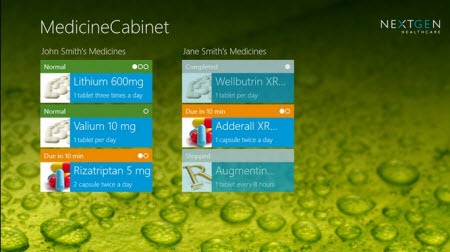
NextGen announces plans to integrate Nipro Diagnostics’ TRUEresult blood glucose monitoring system into NextGen ambulatory EHR, allowing users to view and graph the captured data.

The governor of New York signs a law requiring physicians or their designated employees to check a real-time registry maintained by the state health department before prescribing certain drugs, including oxycodone. The law also requires pharmacists to report each time they dispense the drugs.

8-29-2012 12-35-25 PM

Avon Urgent Care (IN) selects iSALUS Healthcare’s OfficeEMR. ISALUS also announces that Quest Diagnostics has certified OfficeEMR as a Gold Health IT Quality solution based on its interoperability with Quest’s lab orders and results.

8-29-2012 12-40-26 PM  8-29-2012 12-38-57 PM

Consumer Reports publishes ratings on 552 Minnesota physician group practices, based on findings from the Robert Wood Johnson Foundation and Minnesota Community Measurement. Data was based on “quantifiable measures” collected by the practices and focused on diabetes and cardiovascular disease care. Practices were scored based on the percentage of patients achieving all the targets for managing their blood pressure, cholesterol, diabetes, and blood sugar. Sounds like any practice that wants to be included in similar rankings needs an EMR to adequately capture and report the required data. A couple of months ago Consumer Reports published similar ratings for Massachusetts physicians, so maybe Consumer Reports will soon be the go-to source  to identify the best dishwashers, cars, AND physicians.

8-29-2012 12-43-06 PM

Hillcrest HealthCare System (OK) contracts with Phytel to provide its Outreach population health management solution to 100 primary care physicians, along with Phytel Insight for analytics.

8-29-2012 2-56-11 PM

The 300 provider Cornerstone Health Care (NC) selects MedAptus’s Pro Charge Capture solution for coding and billing.

MGMA reports that median compensation for practice administrators of groups with seven to 25 FTE physicians rose almost 5% in 2010 to $120,486. In groups over 26 physicians, however, compensation fell almost 3% from the previous year. In practices with less than six physicians, administrators earned an average of $88,118. Administrators affiliated with the MGMA-ACMPE certification and fellowship programs earned as much as $30,000 per year more than their non-certified peers, a point that MGMA will undoubtedly leverage to promote certification programs.

8-29-2012 3-47-43 PM

HIStalk Practice sponsor Kareo updates its Website and branding to reflect its commitment to small practices and billing services. The Kareo folks tell me the company has doubled in size each of the past three years and now serves 15,000 providers.

Inga large

E-mail Inga.

News 8/28/12

August 27, 2012 News 2 Comments

8-27-2012 3-50-36 PM

From Sleepless “Re: Practice Wise. Julie McGovern’s ‘One Project at a Time’ article was great! If only the business world really would acknowledge how much disruption it creates and the resulting levels of frustration.” Sleepless is referring to Julie’s recent post, which addresses the hard work of EHR implementations and how clinics would be prudent to avoid tackling multiple large initiatives simultaneously. She offers some great tips, beginning with:

If other initiatives must be tackled, try to stage the projects to preserve the sanity of everyone involved.

The one-year delay for the ICD-10 code set is confirmed by HHS Secretary Kathleen Sebelius and the new compliance date is October 1, 2014. Following the announcement, MGMA expressed concerns that HHS didn’t undertake due diligence to ensure ICD-10 won’t disrupt cash flows and recommended additional ICD-10 pilot testing before a full roll-out. Meanwhile, the AMA issued a statement recommending “CMS delay the move to ICD-10 by a minimum of two years.”

8-27-2012 5-03-59 PM

RCM provider ZirMed hires Kenneth Willman (Humana) as VP of payer solutions and strategy.

8-27-2012 5-06-13 PM

I read this profile on startup HealthTap and am not convinced of the model’s viability. HealthTap allows patients to pay $10 to have a secure, private conversation with a physician in a format similar to email. Patients can share documents and images and the doctor then analyzes the case. The patients can choose a physician to engage with “out of a million” in HealthTap’s database (or 14,000 licensed US doctors.) I understand how this could be attractive to a patient, though I have to wonder what kind of doctor would be willing to participate. The company says their site allows physicians to use their knowledge to “build an image” and as a business development tool. I thought we were facing a doctor shortage, not a patient shortage, so how many physicians – particularly quality primary care doctors – really need to recruit more patients? What am I missing?

8-27-2012 5-08-28 PM

Emdeon expands its Clinical Exchange solution to include e-prescription routing, lab orders and results exchange, care alerts, medication history, and clinical messaging.

More evidence of telemedicine’s growing popularity: in a survey of 440 mid to large size firms, 9% indicated they had plans to offer telemedicine consultations in 2013; another 27% are considering them for 2014 or 2015.

simplifyMD adds billing software provider Healthpac as a reseller for simplyMD’s EHR.

8-27-2012 4-39-30 PM

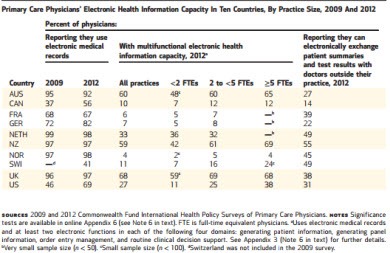
Seventy-five percent of 21,000 physicians participating in a Medscape survey say they use an EHR system, while an additional 20% plan to adopt one in two years. That sounds high to me, but adoption is no doubt trending up. The top-ranked EHRs among smaller practices were Amazing Charts, VA-CPRS, and Practice Fusion, while groups with 25 physicians or more favored VA-CPRS, Epic, e-MDs, and Medent. The most widely used EHRs were Epic, Allscripts, and Cerner.

Last week on HIStalk we mentioned some key items from the Stage 2 MU final rule, which was published last week. A few items impacting EPs include:

  • Stage 2 will begin in 2014, a full year later than the date published in the original ARRA legislation. Providers have two years after achieving Stage 1 to achieve Stage 2.
  • Providers don’t have to achieve Stage 1 MU until 2017, though Medicare penalties will begin in 2015.
  • EPs have a new core measurement requiring at least 5% of patients seen by the EP to use secure messaging to communicate health information.
  • Hospital-based physicians who can demonstrate they funded the purchase, implementation, and maintenance of an EHR without reimbursement from the hospital and use the EHR in place of the hospital’s EHR can apply to receive a MU payment.
  • Certain physicians that don’t have a lot of face-to-face time with patients can apply for an exemption to the MU program to avoid Medicare penalties. Exceptions are also possible for physicians that live in geographic areas without sufficient Internet access and those subject to unforeseen circumstances, such as natural disasters.

Inga large

E-mail Inga.

Practice Wise 8/26/12

August 26, 2012 News Comments Off on Practice Wise 8/26/12

One Project at a Time!

We as a human race are experts at creating our own chaos. Just check out the news on any given day for proof. Less publicly advertised is the chaos unfolding in clinics and hospitals all over the country as they make the move to EHR.

What I find most intriguing is the clinics who also decide it’s prudent to simultaneously tackle other large projects and initiatives. EHR implementation is hard work, just in case you’ve not been down this road yet. It is incredibly disruptive to all organizations. Processes may not radically change, but determining how those processes will be performed takes much thought and effort every time you perform them.

If other initiatives must be tackled, try to stage the projects to preserve the sanity of everyone involved.

Some things to consider when doing an EHR implementation:

  1. If you plan on doing a clinic remodel (which might be necessary to accommodate computers and new workflows), do that prior to implementation, not the week of go-live. It’s stressful to move computers around after a day of using a new system. Even having the computers in a different place the next day can cause disorientation and confusion for all users.
  2. If you plan to replace your phone system, consider that these, too, are computers. You’ll be learning to use another new tool with complex processes, which can take away the ease of answering a call and putting it on hold. This is another frustration point and can be exasperating. Don’t over exasperate yourself!
  3. New computer hardware, and operating systems are likely a must-do item for your implementation. Do not order your new systems to arrive right before you go live on EHR. Your staff are not likely to be network engineers, and the differences between Windows XP and Windows 7 — soon to be the completely different Windows 8 — or Office 2003 and Office 2010 are so vast, it’s another point of disorientation for the staff. There is a learning curve involved in these upgrades, and clinics rarely consider additional training for operating system and Office product upgrades. We all just assume we can figure it out on the fly. This is a bad decision. The loss of productivity when employees are trying to figure out logins (user name requiring a domain\user configuration in W7) has kept staff from being able to log in to their computers. If you are doing a major system upgrade of computers, consider this another implementation and treat it as such. Get training!
  4. Other initiatives such as Patient Centered Medical Home may be part of the reason you are moving to an EHR. However, trying to meet all the goals and measures of PCMH at implementation is not realistic. Don’t set yourself up to meet some reporting deadline within the first month (s) of your EHR installation.

EHR implementation can be compared to being pregnant. There is a beginning, middle, and end. In the beginning, you are tired and often feel like you have morning sickness. The first trimester is the hardest. In the second trimester, you start to get your legs under you, your energy starts to return, and you feel less beaten down by the EHR. By the third trimester, you start to see the light at the end of the tunnel, it’s starting to be second nature, the product is making more sense (hopefully), you’ve got good workflows and everyone is starting to forget how hard the first trimester was.

If you are going to tackle multiple projects and initiatives, consider doing them before you get pregnant if they are pertinent to a healthy pregnancy (buying computers for the EHR), or else wait until your third trimester or later when you can handle the extra burden gracefully.

Don’t create more chaos than you’ll already have with your EHR implementation!

Julie McGovern is CEO of Practice Wise, LLC.

News 8/23/12

August 22, 2012 News Comments Off on News 8/23/12

8-22-2012 5-36-33 PM

Walgreens plans to deploy the WellHealth EHR, built upon Greenway Medical Technologies’ EHR platform, to nearly 8,000 stores over the next year. The WellHealth EHR platform, which is already installed at 200 sites, provides pharmacy staff with a single patient view of immunizations, testing history, and prescription history.

8-22-2012 4-09-53 PM

CMS selects 500 primary care practices across seven regions to participate in the Comprehensive Primary Care initiative, which will pay primary care practices a care management fee of $20 per month per beneficiary to support enhanced coordinated services on behalf of Medicare FFS beneficiaries. Participating practices were selected based on their use of HIT, ability to demonstrate recognition of advanced primary care delivery, and participation in practice transformation and improvement activities.

8-22-2012 3-34-44 PM

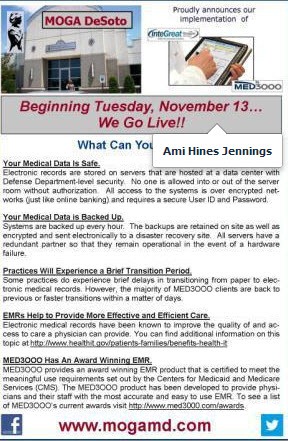
CPU Medical Management, a division of MED3OOO, announces a vendor partnership with eBridge to offer a combined PM and document imaging solution.

Quest Diagnostics certifies Meditab Software’s Intelligent Medical Software as a Gold Health IT Quality Solution that provides a streamlined and interoperable solution with Quest’s lab orders and results.

If you are a physician, you are more likely to experience symptoms of burnout than individuals in other professions, according to a study published in the Archives of Internal Medicine. Of 7,299 physicians surveyed, almost half claim to be emotionally exhausted or feeling a high degree of cynicism, or depersonalization toward patients. The specialties with highest burnout rates are emergency medicine, family practice, and internal medicine.

8-22-2012 5-35-30 PM

Mobile health app store Happtique pilots mRx, a solution that enables physicians to prescribe medical, health, and fitness apps to their patients. Physicians and licensed health practitioners, such as nurses, dietitians, and therapists can select apps to prescribe and Happtique will track how many times patients clicked the “fill” button after an app prescription is sent. App usage, however, will not be measured, nor will clinical outcomes. My take: sounds fun but it won’t take long for patients to lose interest.

Inga large

E-mail Inga.

Platinum Sponsors


Gold Sponsors


Subscribe to Updates


Search All HIStalk Sites


Recent Comments

  1. The article about Pediatric Associates in CA has a nugget with a potentially outsized impact: the implication that VFC vaccines…

  2. Re: Walmart Health: Just had a great dental visit this morning, which was preceded by helpful reminders from Epic, and…

  3. NextGen announcement on Rusty makes me wonder why he was asked to leave abruptly. Knowing him, I can think of…

  4. "New Haven, CT-based medical billing and patient communications startup Inbox Health..." What you're literally saying here is that the firm…

  5. RE: Josephine County Public Health department in Oregon administer COVID-19 vaccines to fellow stranded motorists. "Hey, you guys over there…