Home » News » Recent Articles:

Practice Wise 1/20/12

January 20, 2012 News 2 Comments

New Year’s Resolutions I Hope to Fulfill

I gave up making personal resolutions years ago, when I realized I never stuck to them past January 10. But I do try to set a few resolutions or personal business goals at the start of every year. These aren’t business plan type financial goals. Instead, they are usually relationship growth goals.

As the owner of a small consulting firm serving mostly small to medium practices (with a few bigger systems thrown in the mix,) I have the opportunity to have very personal, almost intimate relationships with our clients. We are part of their practice family. We know a lot about their personal lives, and they about ours. I’m constantly striving to improve those relationships. They are the lifeblood of my business; the reason we exist.

Resolution #1: help my clients to understand the importance of their vendor relationships and how to foster them into practice family relationships. In particular, as practices adopt EMR software, they need to incorporate their EMR vendor and their IT support vendors into their team. I want to help my clients understand the value of their technology, and more importantly, the value of their technology partners in their practice success. With standardization of the elements of certified EMR products and generally standardized hardware, the value of technology is not solely the technology itself, but the partners who make technology successful in the practice.

I had a third-party business associate comment to me the other day that in all his years in business, he’s never seen customers treat their vendors the way that some medical practices treat their IT support vendors. He didn’t mean that in a positive way. He observed interactions between practices and their technology support vendors and was shocked that the clients were making demands and laying down ultimatums. In his mind, the demands seemed unreasonable.

It got me thinking about out why perfectly intelligent and reasonable people can seem so unreasonable and difficult to please when it comes to their computer environment. Of course, there are many factors at play here. It’s no secret that the medical field is anywhere from 10-15 years behind corporate America in the adoption of business computer systems. Smaller practices are at the tail end of that curve. They are approaching all of these major business technology changes to their practice with the adoption of EMR from a bit of a disadvantage.

Many small to medium practices don’t even use corporate e-mail before they move into a complex EMR. They often don’t understand the difference between buying a computer with Windows 7 operating system and Office 2007. They have no frame of reference of how these things should work. Nobody has set expectations for them. Vendors recommend solutions, install them, tell them how they work, and expect that they will be effective users and grateful support customers at the end of an implementation. The customers think if it’s a complex technology, it should just work. They are frustrated and fearful. We’ve upended the way they practice medicine. They don’t know what to expect. We have failed them by not setting realistic expectations.

Resolution #2: set realistic and appropriate expectations. OK, I could use this one is all areas of my life, but that’s another story. In relation to my business, my goal is to help define appropriate support expectations with my clients. Not only for my firm, but with all the vendors that help my clients keep their practices running.

We know that end users become effective with ongoing support. Part of that support should be educational about the processes, not just the products. For instance, I had a provider complain that we do too many software updates to his EMR; he only wants one a year. He thinks updates are about new features and functionality only. I showed him the Microsoft Automatic Updates history on his computer. It was setup to download and install automatically at 3:00 am.

He wasn’t aware that this was happening weekly. It answered his question as to why on Wednesday mornings when he comes in, his computer is rebooted and all his applications from Tuesday are closed. He thought he had a computer problem and nobody believed him that some days his computer rebooted itself. Understanding what software upgrades entail and why they are necessary was not something he ever thought about, until he started using an EMR.

We can’t expect them to set expectations of how their products or vendors will perform if they’ve never experienced these in the past. I certainly would have appropriate expectations about a cardiothoracic surgical procedure outcome having had no experience with one.

This is not a new discussion. There was an excellent post on this site last year about having empathy and compassion for the customer, and likewise, the customer for the support team. It dealt primarily with internal hospital teams. Those of us who provide support services to private medical practices have the extra challenge that these are our paying customers. We don’t have control over their environment or unsolicited sway in their culture. If they don’t feel like their needs are being met, they’ll take their business elsewhere.

And let’s be clear: not all vendors are created equally. There are plenty of vendors who do not meet even the minimum expectations, set or not.

Someone will read this and state that it is elementary and pedantic. Nevertheless, I see hundreds of providers in small practices, and by and large, they are in the same boat. I have a handful that are really computer savvy and understand what to expect. I value my clients and the work I get to do with them. I want to make sure they are given the opportunity to play on an even playing field, knowing all the rules of the game, so that they can be successful in this part of their business.

We can all help them set appropriate expectations. Then, hold them and us — the vendor community — to those standards. We can only expect them to have reasonable expectations if we agree to them, and then meet them.

At least I won’t be fretting over another year of wasted gym membership fees after another failed resolution to start exercising and lose 15 pounds.

Julie McGovern is CEO of Practice Wise, LLC.

News 1/19/12

January 18, 2012 News 1 Comment

Greenway Medical Technologies hopes to raise $80 million in its upcoming IPO with the sales of 6.67 million shares at $11 to $13 a share. Company valuation could hit $347 million, if all shares sell for $13 each. No official word on the date for IPO, but at least one investor predicts February 2nd.

1-18-2012 12-22-16 PM

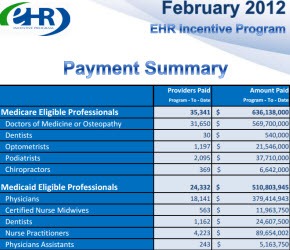
CMS releases attestation figures for EPs participating in the Medicaid EHR incentive program. Through the end of December, 14,089 EPs received $295,760,910 for their meaningful use of EMRs. That compares to $274,590,000 paid by Medicare to 15,255 EPs.

1-18-2012 6-09-51 PM

Quest Diagnostics announces a grant program to provide eligible providers an 85% discount off the retail price of its Care 360 EHR, including fees for licensing, hosting, support, training, and implementation.

1-18-2012 11-48-24 AM

I noticed on eClinicalWorks’ Facebook page that they sponsored a blood drive at the corporate headquarters on Wednesday. Very cool.

The Arizona REC adds PatientClick EHR to its Vendor Alliance Program.

1-18-2012 6-11-11 PM

Meramec Valley OB/Gyn (MO) selects Benchmark’s billing and clinical solutions.

Physicians who have an ownership interest in their practice are more likely to consider EHR implementation difficult because they bear a certain amount of financial risk related to owning, operating, and managing a medical practice.

1-18-2012 6-11-57 PM

The Kentucky REC reaches its initial program goal of 1,000 enrolled primary care providers.

1-18-2012 4-08-49 PM

Please join me in welcoming HIStalk Practice’s newest platinum sponsor, Humedica. Humedica provides SaaS-based clinical intelligence solutions that connect patient information from varied medical settings and time periods to generate a real-time longitudinal view of patient care. The Boston-based company offers MinedShared Ambulatory, which supports clinical, operational, and financial benchmarking and earned the highest overall rating of any clinically focused BI vendor in last year’s KLAS Business Intelligence report. Humedica partners with Allscripts, as well as AMGA subsidiary Anceta, and recently announced a new predictive analytic model to identify patients at high-risk for CHF hospitalization. Many thanks to Humedica for supporting HIStalk Practice, as well as HIStalk.

Want to learn more about Humedica? Check out Mr H’s interview of  President and CEO Michael Weintraub last month.

1-18-2012 4-33-22 PM

The AMA and TransforMED release three online educational tutorials to help physician practices better implement HIT and cover ePrescribing, pre-visit planning, and point-of-care documentation.

1-18-2012 6-13-14 PM

A study by UC Davis Health System researchers finds that care for dermatology patients is usually enhanced by specialty consultations via telemedicine. The research team found that live interactive consultations can improve clinical outcomes because the consults usually involve beneficial changes in medical diagnosis and disease management.

Inga large

E-mail Inga.

DOCtalk by Dr. Gregg 1/17/12

January 17, 2012 News 1 Comment

I Can’t Get No…

Every once in a while I put on a pair of skin tight leather pants, rip off my shirt, puff up my lips, and strut about frenetically with arms akimbo – somewhat like a chicken – singing Mick and company’s famous line “ I…can’t…get…noo-o… …sa…tis…fac…tion.” (There’s a visual for you!)

Having peeled the leather off and slipped into some much more age-appropriate sweat pants, I’ve stopped strutting and will now explain my lament, which of course has an HIT riff running through it.

I still love my EHR, Bond Clinician. (Since it was acquired-acquired-acquired and then sunsetted, I no longer feel any obligation to call it by anything other than its original, Bond-given name.) Yes, it has features and functionality that are less than optimal, but after looking about with a fair degree of diligence this past year, I still haven’t seen another EHR out there that comes close for overall look, feel, or technical sexiness. But, sadly, my beloved Clinician will grow more and more anachronistic as it stays forever trapped in the annals of HIT throwaways. I need to find my next EHR “Brown Sugar.”

Don’t get me wrong; I have seen some very attractive and some very functional EHRs. The problem for me, though, is mainly two-fold:

1) The good-looking EHRs are rarely evolved enough or complete enough or else they come with a heavy dose of an EHR provided to bolster the practice management/billing tool or else they’re designed to promote some other principal focus (e.g., labs) or;

2) The more highly functional EHRs are almost always just plain butt-ugly (not unlike the aforementioned Mr. Jagger.)

As I’ve stated before, I’ve seen some fantastic parts and pieces that combine both the design elegance and the Apple-esque usability that I seek. Thus, another Mick-generated semi-proverbial lyric applies: “You can’t always get what you want, but…sometimes…you can get what you need.”

The spoiled, angst-filled, teenage brat inside me rebels against this, though. My inner little monster whines, “I’ve seen beauty in EHRs. I was a part of the design team for ‘Notes 2.0’ for Eclipsys’ Peak Practice, nee Bond Clinician, which was headed toward the EHR hall of fame for both its beauty and its tech savvy wizardry. Waaaah. I want a beautiful EHR that’s just as full of gorgeously implemented function as Clinician 2.0 would have been and just as easy to use as my iPad. I want all those great parts and pieces in one fully integrated EHR. Waah, waah!”

I’ve listened to far too many vendor hyperboles to even be swayed anymore by the sales pitches. No, your tools aren’t the end-all, be-all for medical practice record keeping. No, your patient portal isn’t going to drive swarms of new patients to my door. No, your billing and scheduling functions aren’t seamless. No, “functional” is not the same as “good.” No, “usability” isn’t just about “easy click-ability” or voice recognition. No, gathering useful data is not the same as having data gathered usefully.

I again hear Mick sing “…but if you try sometimes…” when a few vendors have asked me to contribute to their product’s development over this past year. Helping create the visually-stunning and truly provider-friendly system that would lead me back to the contentment I now feel with my dear Clinician is intriguing. I mean, I helped Clinician move up the food chain and I’ve learned tons since then. I understand at least a thing or two of what it takes to make digital healthcare click. Plus, I’ve developed a pretty wide-ranging overview of this industry from my little trench (and more than a few connections that could be really handy.) Maybe I can help develop an EHR to provide a similar sense of system satisfaction to that which I now feel with my dear Clinician – and, hopefully, help some fellow providers feel the same as they digitize.

Thus, I’m considering the possibilities, at least with a couple of them. I’m not yet committed because it isn’t just the consulting that’s important to me: the heaviest factor is that I’ll be also using it as my next EHR, using it every day. Being a happy with what I currently have makes the thought of changing a bit tough.

With a rather different position, perspective, and experience base than most docs (who are typically less geekoid, likely to their benefit,) it does make some sense to try to make a difference. “But, I try, and I try, and I try, and I try…,” goes the Mick within my head.

If I do go the consultancy way in some form or another, I’ll try to create a relationship that doesn’t cloud my trench grunt blogger perspective. I absolutely need to get on with getting a new EHR, but I highly value the honor of being able to write “from the trenches” here on HIStalk/HIStalk Practice and want to maintain the uncluttered honesty it allows.

Mr. Jagger has said, “It’s all right letting yourself go, as long as you can get yourself back.” My fear: some consultants never quite seem to make it back.

From the Stoned trenches…

“I’d rather be dead than singing ’Satisfaction’ when I’m 45.” – Mick Jagger

Dr. Gregg Alexander, a grunt in the trenches pediatrician at Madison Pediatrics, is Chief Medical Officer for Health Nuts Media, directs the Pediatric Office of the Future exhibit for the American Academy of Pediatrics, and sits on the board of directors of the Ohio Health Information Partnership (OHIP).


News 1/17/12

January 16, 2012 News 1 Comment

From REC Fan “Re: Meaningful Use deadlines. I just got this email from CMS that has some good reminders for EPs. The deadline for registering and attesting to meet MU and receive payment for the 2011 calendar year is February 29, 2012. February 29th is also the last day EPs can submit pending Medicare Part B claims for CY 2011. Providers who applied to for MU incentives but did not met the $24,000 threshold for Part B allowed charges should look for their incentive checks (based on 75% of the EP’s charges) sometime in April.” REC Fan also forwarded this link for EPs who interested in registering and attesting.

Princeton Orthopaedic Associates (NJ) selects SRS EHR. Speaking of SRS, CEO Evan Steele recently shared with me that last year the company grew its revenue 37% over 2010’s results and increased sales by 104%.

1-16-2012 12-05-58 PM

Omaha Imaging (NE) selects Atlantic Health Management Solutions to provide billing, collections, and provider contracting and credentialing for its eight physicians.

The Arizona REC adds Navicure to its Vendor Alliance program.

1-16-2012 12-27-10 PM

The AMA updates the website for its Practice Management Center, which is accessed by about 7,000 visitors a month. Among changes, AMA has added a Knowledge Center that provides access to practice toolkits, webinars, and white papers.

1-16-2012 12-31-03 PM

Physician offices added 67,600 jobs in 2011, which is more than double the 25,300 created in 2010 and the second highest number in the last 10 years.

MED3OOO points out that  KLAS scores for its InteGreat EHR increased 11% over the last year.

1-16-2012 4-25-36 PM

I noticed that athenahealth’s 2012 User Conference is coming up April 1-4 in Boston.  What really caught my eye was mention of the keynote speaker, Abraham Verghese, who authored of one of my favorite reads, Cutting for Stone. I am sure the 50 different educational sessions will also be great.

Small to medium-sized practices plan to buy tablets at a faster pace than larger practices in 2012, with 73% of the smaller offices expecting to make a purchase. Practices anticipate spending on average a cumulative total of $6,800 on tablets over the next year.

Gateway EDI’s director of client services says that small labs and physician offices of one to five doctors are experiencing more problems than larger organizations in the transition to 5010. Gateway’s Jackie Griffin attributes the problems on smaller entities’ lack of resources to prepare for the transition and predicts most will experience a financial shortfall over the next 45 days. I wonder if other vendors and practices agree with Griffin’s assessment. 

Inga large

E-mail Inga.

News 1/12/12

January 11, 2012 News 9 Comments

1-13-2012 1-52-10 PM

CMS releases a Meaningful Use Attestation report from November 2011 that provides insight into which EHRs have the most attestations. I played with the numbers a bit and created this chart showing the top ambulatory EHR products in terms of attestations. EpicCare Ambulatory tops the list with 28% of the 21,318 attestations; eClinicalWorks follows with less than 9%, Allscripts Professional at 5.6%, and athenaClinicals is at 5%. And if you combine all of Allscripts’ ambulatory EHR products, they have 7% of the ambulatory EHR attestations. Fascinating stuff that raises questions, such as what percentage of vendor users does each attestation number represent? For example, eClinicalWorks reports having 60,000 physicians on their combined PM/EHR product, meaning only 3% of their providers have attested. That compares to athenahealth, which claims to have 6,000 athenaclinical providers, meaning 20% of the EHR providers have attested. It will take some time to find more facts and figures, but I’m hoping to dig deeper. [Update from Inga: Based on the vast differences in practice demographics and reasons for buying a particular EMR product, comparing  each vendors’ percentage of attesting providers may have limited value. For example, though eCW has 60,000 physician users, a significant number are CHC providers who are ineligible to qualify for MU incentives. A vendor offering a free solution, such as Practice Fusion, may attract more providers who are more interested in basic EMR functionality than in qualifying for MU incentives. Regardless of how you crunch the numbers, however, the overall number of EPs attesting through November (21,318) seems quite low.]

1-11-2012 3-28-08 PM

By the way, CMS says that as of December, 35,515 EP had successfully attested for Medicare Meaningful Use incentives. while another 355 were unsuccessful. Medicare paid EPs $275 million.

Practice Fusion announces it has raised an additional $2 million in funding. The company has now raised over $38 million from Band of Angels, Felicis Ventures, and others.

1-11-2012 5-48-18 PM

Adventist Health will implement Cerner Ambulatory EHR across its 130 outpatient clinics.

1-11-2012 5-49-56 PM

Winchester Radiologists (VA) contracts with HealthPro Medical Billing to provide billing services for its 17 physicians.

Massachusetts Eye and Ear Associates selects PatientKeeper Charge Capture and PatientKeeper P4P for its 250 clinicians.

Billing service provider MedData acquires MedDirect, a provider of RCM management and patient communication services.

Idaho Health Data Exchange (IHDE) signs an agreement with Greenway Medical to provide interoperability between Greenway’s PrimeSUITE EHR and IHDE’s HIE.

1-11-2012 5-58-07 PM

The American Podiatric Medical Association partners with HealthFusion to promote the use of HealthFusions’s MediTouch EHR.

The number of retail clinics grew 11.2% last year to 1,355 and is predicted to continue growing into 2012. One reason: the forecasted increase in demand for medical care, fueled by health reform and more access to medical coverage. CVS, one of the country’s largest retail clinic, plans to open 500 new MinuteClinics over the next five years.

Age makes a difference when it comes to physicians perceiving benefits of HIT. The majority of US doctors believe that technology does not improve diagnostic decisions, improve health outcomes, or improve the quality of treatment decisions. Most doctors under the age of 50, however, believe HIT offers numerous benefits, including a positive impact on outcomes, faster access to health services, reduced medical errors, and improved care coordination.

Inga large

E-mail Inga.

Platinum Sponsors


Gold Sponsors


Subscribe to Updates


Search All HIStalk Sites


Recent Comments

  1. The article about Pediatric Associates in CA has a nugget with a potentially outsized impact: the implication that VFC vaccines…

  2. Re: Walmart Health: Just had a great dental visit this morning, which was preceded by helpful reminders from Epic, and…

  3. NextGen announcement on Rusty makes me wonder why he was asked to leave abruptly. Knowing him, I can think of…

  4. "New Haven, CT-based medical billing and patient communications startup Inbox Health..." What you're literally saying here is that the firm…

  5. RE: Josephine County Public Health department in Oregon administer COVID-19 vaccines to fellow stranded motorists. "Hey, you guys over there…