News 11/9/10

November 8, 2010 News Comments Off on News 11/9/10

certification status practice fusion cert

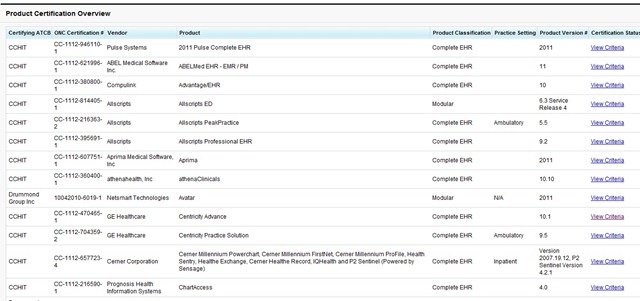
From Zuckerberg: “Re: ONC ACTB EMR certification. Several EMR vendors are making a big deal out of partial certification and deserve some grief. Partial certification is meaningless – you think physician practices are going to buy multiple products and integrate them? I can understand partial certification for hospitals, but for physicians, this is crazy. Novice physician buyers are going to see that a vendor is ‘certified’ and assume that they are good to go. They’ll only find out after a lot of effort that what they’ve implemented isn’t going to deliver the goods.” I agree the “modular” versus “complete EHR” certification will cause confusion for some unsophisticated buyers. I’d suggest novice physicians refer to the ONC’s list of certified products, which includes designations for modular versus complete EHR certifications. You can also drill down to see what specific modules have been certified. More importantly, ONC indicates which modules within a particular product are not certified. If an EHR has only modular certification, providers will need additional applications in order to meet meaningful use requirements. Unlike Zuckerberg, I assume vendors are being up front and forthcoming about potential product gaps, but perhaps I am too optimistic. The winners here are consultants, who have the opportunity to help providers wade through the quagmire.

jb shorts

From Jack Dempsey: “Forbes article. HIT wouldn’t be as much fun without Bush.”  Forbes’ Zina Moukheiber likens the “sniping” between athenahealth’s Jonathan Bush and eClinicalWorks Girish Navani to a Bill Gates-versus-Steve Jobs type debates. I’m not sure I’d characterize Bush or Navani as snipers, though both leaders are definitely passionate about their companies and their business models. Bush, however, is the only CEO I’ve ever met who’s willing to sit in on a panel discussion wearing a suit jacket and red shorts.

Mercy Memorial Hospital System (MI) contracts with Allscripts for several clinical solutions, including EHR and PM for Mercy’s employed and affiliated physicians. Mercy is also adding Sunrise Enterprise 5.5 and Allscripts Care Management.
jeff sturges

Speaking of Allscripts, Sales President Jeffrey A. Surges is leaving to take over as CEO of Merge Healthcare.

A Kaiser Permanente study finds that targeted alerts sent to physicians through EHRs can help decrease unnecessary tests and help physicians pay closer attention to the messages they receive. In Kaiser’s study, physicians who ordered specific blood tests for elderly patients were immediately alerted when typical results for that age group were unreliable. Kaiser found unnecessary tests were dramatically reduced. To reduce alert fatigue and promote adherence to clinical practice guidelines, researchers recommend implementing alerts for specific types of orders.
ehr survey 

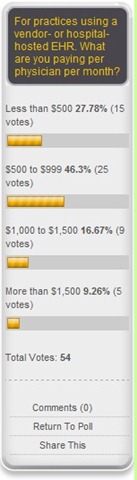
Forty-six percent of readers say their practice is paying between $500 and $999 a month for their vendor or hospital-hosted EHR. Another 28% say they pay less than $500 and the rest claim the cost is over $1,000 a month.

Allscripts releases its third quarter numbers: net income falls to $1.4 million from $12.9 million last year. Revenue rose 47% to $242.4 million. Excluding one-time items, earning were $.19/share; analysts were expecting $.17/share. Allscripts blames the income drop on higher expenses, including selling, general, and administrative expenses of $103.8 million compared to last year’s $53.0 million.

MedLink acquires the assets of EHR provider MedAppz, maker of the iSuite EHR.  Both MedLink and MedAppz have products that are 2008 CCHIT certified and neither appears to have earned ONC ACTB certification, at least to date. I’ll go out on a limb and say that I bet MedLink would like to find a way to certify just one EHR and move the combined client base to it.

Epocrates and Covisint team up to help physicians receive PQRI reimbursements from CMS. The partnership allows the 300,000 physicians in the Epocrates network to report on quality measures through Covisint’s DocSite PQRI registry.

gloemr

A local paper reports that Troy, MI-based gloStream has added 50 new employees in the last year. The five-year-old company has 130 employees plus 15 independent contractors.

Trend alert: the number of physicians signing up to provide concierge medicine continues to grow. Concierge Choice Physicians says it has added over 50 practices since the start of the year and now includes 172 practices. MDVIP, which has 430 practices, has signed on 100 practices in the last year.


inga

E-mail Inga.

Intelligent Healthcare Information Integration 11/5/10

November 5, 2010 News 4 Comments

But What Do I Know?

I’ve been looking at a whole lot of EHRs and their web sites lately, looking for my "next great system." Maybe they’re just starting to blur together in my brain, but it looks as if every single EHR out there will improve my workflow, decrease my errors, increase my productivity, improve my bottom line, get me home earlier, make my life easier, and guarantee my MU bucks. Somehow the redundancy of hype doesn’t increase my interest…but what do I know?

Back in 2004, I remember thinking that the majority of EHRs looked a whole lot like Windows 95. Not much has changed. I used to think that most EHR developers would soon learn the value of style, of "eye friendliness" for meeting the wide variety of end user tastes, or that at least they’d develop "skinning" for their systems to help solve the problem of ugly EHR user interfaces. I remember thinking how much better they’d all look within the next five years…but what do I know?

I remember when you moved from one medical practice to another, from one type of paper chart to another, and it took all of about thirty seconds to figure out what went where and how to find the info you needed. Seems that the multitude of "modern" electronic charting systems could stand to be reminded of that…but what do I know?

Seems as if every report I receive via fax or hard copy from (fill in the blank) EHR is either way too long and filled with mostly irrelevant "filler" data or way too short and lacking essential, clinically valuable elements. Seems as if very little effort is being spent, at any level, on truly defining what clinicians actually "need" and how to make that information apparent, easily visualized, and perhaps even somewhat standardized when it comes to knowing where to look for any given piece of info…but what do I know?

Doctors used to be paid for their knowledge, for their experience, for their clinical skills, and their wisdom. Nowadays, it seems we’re paid mostly for data capture. I think patients still want good “doctoring”…but what do I know?

It may just be me, but there appears to be an increasing similarity between how insurance companies deal with clinicians and how more and more EHR vendors are starting to treat us…but what do I know?

I read that independent providers aren’t flocking to EHRs quite as much or as fast as hoped despite the ARRA/HITECH incentives. I’m thinking it might be because of some of the above concerns and just how difficult it is to actually change virtually everything about how you work while you’re busy actually trying to do the work…but what do I know?

For myself, I’m also hesitant to make another EHR choice. Having lived through three EHR company acquisition-mergers which eventually led to the Kevorkianization of a really smart, sexy system that was just reaching a respectable maturity, I’m pretty sure more this same digital tragi-drama will happen to many other decent systems over the next few years…but what do I know?

Don’t get me wrong; I see systems which do some things very well and I know a whole lot of EHR vendor folks who I think are just plain wonderful. Good people and good intentions are important, but I’m still thinking I want a beautiful system that works as easily as my iPad and as intelligently as WebOS, one that I can start using as simply as I need and which can then be "apped" silly at my discretion, one that is actually as good and as smart as all the hype…but what do I know?

From the trenches…

“Committee – a group of men who keep minutes and waste hours." – Milton Berle

Dr. Gregg Alexander, a grunt in the trenches pediatrician, directs the “Pediatric Office of the Future” exhibit for the American Academy of Pediatrics and is a member of the Professional Advisory Council for ModernMedicine.com. More of his blather…er, writings…can be found at hisblog, practice web site or directly from doc@madisonpediatric.com.

News 11/4/10

November 3, 2010 News 1 Comment

Radiation Therapy Services, dba 21st Century Oncology, selects Sage Intergy for its 90 radiation therapy centers across 16 states.

The University of Wisconsin-Madison’s Center for Quality and Productivity Improvement takes a look at the effects of HIT tools on physician workflow in the outpatient setting, noting that previous studies have shown varied results. It’s a long read but here are a few conclusions worth noting:

  • There is growing awareness that the analysis of workflow is necessary to ensure successful HIT implementation and to effect process improvement.
  • When there’s a lack of integration of HIT into clinical workflow, quality and safety improvements suffer. HIT integration needs to support the cognitive work of the clinician and the workflows among organizations (e.g., between a clinic and community pharmacy), within a clinic, and within a visit.
  • If HIT is to provide optimum performance, it must be designed to fit the specific context in which it will be used, specifically practice and patient types.

core

Core Solutions, which specializes in behavioral health software solutions, wins a contract to implement an EHR for 60 substance abuse providers affiliated with the Arkansas Office of Alcohol and Drug Abuse Prevention.

I’m glad the elections are over, along with the annoying political commercials and even more annoying phone calls. Over the next few weeks look for the lame-duck Congress to patch pending Medicare cuts before the 30% payment reductions kick in.

From the International Journal of Medical Engineering and Informatics: self-management of chronic disease can improve patient health and reduce hospital visits, and, PHRs and the use of the Internet have the potential to help patients better manage their diseases. Too bad no one wants to use PHRs.

avvo

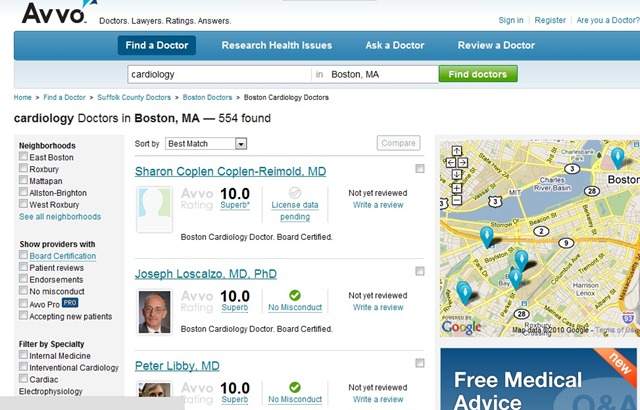
Start-up company Avvo announces it will expand its free online ranking services to include rankings of physicians. Avvo debuts with listings for over 800,000 doctors, drawn from public records and company research into doctors’ backgrounds and experience. Any predictions as to whether or not they’ll be able to filter out the retired/deceased/imprisoned physicians?

I happened upon this commentary by a couple of attorneys who specialize in negotiating HIT contracts between practices and vendors. They point out that one of the key services that RECs can provide is educating providers on HIT contracts, including some of the important provisions to minimize risk and to improve chances of achieving meaningful use:

RECs have the potential to serve as a valuable resource, especially for remote and underserved paper-based primary practices. However, RECs could be doing a disservice to physicians by failing to advise or provide them with essential EMR contract negotiation skills.

mckesson mu

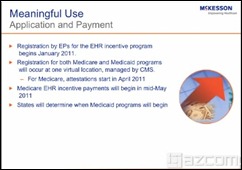
I was surfing YouTube today and noticed a recently posted series of videos highlighting a presentation by McKesson Sales National Sales VP Tammy Eden of the Physician Practice Solutions division. Each of the 10 clips are three to four minutes each and overview the final rules of the HITECH Act, the requirements for qualifying for Meaningful Use, and how to actually apply for reimbursement. The information is generic enough to be a great tool for anyone needing summary information, regardless of your EHR, and definitely worth a peek.

inga

E-mail Inga.

News 11/2/10

November 1, 2010 News 3 Comments

 100million

The eClinicalWorks 2010 Users’ Conference is in full swing at The Gaylord Palms Resort in Orlando with a record 2,500 participants. As part of the event, eCW introduced its Version 9.0 product and launched its new 100millionpatients.com portal solution.

digiChart and MDAdvantage Insurance partner to extend malpractice discounts for physicians who use digiChart OB-Gyn EHR. digiChart will also offer software discounts for physicians covered by MDAdvantage.

NaviNet, a company traditionally known for healthcare communication services, introduces a practice management and EHR solution that integrates with NaviNet’s Insurer Connect payer portal. The PM/EHR solution is based on CureMD’s platform, so I am guessing that NaviNet is putting its private label on the CureMD technology.

curemd drt

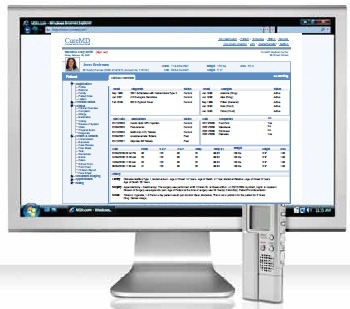
Meanwhile, CureMD launches discrete reportable transcription (DRT). Doctors who want to transcribe clinical notes can use CureMD’s overnight transcription service, then have the DRT technology directly populate discrete items into the CureMD’s EHR.

Quality Systems (NextGen) reports Q2 numbers: revenue up 14% to $81.5 million, EPS $0.46 vs. $0.41, with both revenue and earnings falling short of expectations. The Street was looking for $85.7 million and $0.49.

The Tri-State REC, based in Cincinnati, releases its list of five supported EHR vendors and products. The list includes Allscripts Professional, athenaclinicals, GE Centricity, eClinicalWorks EHR, and NextGen EHR. Supported vendors will extend special pricing and terms to providers working with Tri-State, but the REC’s director says Tri-State is “committed to working with any practice or provider, regardless of which certified EHR vendor they choose.”

No surprise here: primary care physicians, on average, have the lowest income of doctors in any medical specialty based on hours worked. Primary care docs earn about two-thirds of general surgeons, averaging $60 an hour compared to surgeons, who make $92 an hour. The top paying specialty is neurosurgery ($132 per hour), followed by radiation oncologists ($126 per hour). Primary care physicians averaged 51.2 hours a week compared with the 59 put in by surgeons, 57.9 by subspecialists, and 47.4 by "other" physicians.

welch allyn

The REC Ohio Health Information Partnership is working with Welch Allyn to offer providers the Welch Allyn EHR Prep-Select service, which helps practices pick their EHR  and achieve Meaningful Use.

Gateway EDI launches Patient Exchange, an online patient portal that includes billing statements and online pay options.

The AMA collaborates with Press Ganey to provide physicians with a Web-based tool for measuring patient satisfaction. Using an electronic survey, the RealTime solution collects and evaluates patient feedback and generates reports and summaries to identify satisfaction trends.

AZZILY will integrate MaxMD’s mdEmail service into is EHR/PM/PHR application. I chatted with the AZZILY folks last week at MGMA and they plan to official launch their product later this year.

Correction: I mentioned recently that an Allscripts exec told me that Travis Bond (founder of Bond Medical) is a new Allscripts MyWay reseller. I have since learned the executive was incorrect — he’s not.

October was another record month for HIStalk Practice with our highest number of visits ever (11,358). Views were up 38% over last October and overall readership is 24% higher for the year. Over 900 confirmed subscribers receive a handy notice in their inbox every time we have a new post. If you are not one of those confirmed subscribers, sign up for e-mail updates to your right. Also, share your love with our sponsors by visiting their sites and checking out their offerings. And if you think you’d like to be a sponsor, click on the sponsorship link at the top of the page. Thanks for reading and for telling your friends that they are unhip if they aren’t tuning in.

O’Brien’s Billing, a New York-based billing service specializing in mental health, selects Kareo as its billing software solution.

kareo banner

Speaking of Kareo, I’d like to welcome the company as our newest HIStalk Practice Gold Sponsor. Kareo offers a Web-based practice management and medical billing software that includes integrated electronic claims processing. Its pricing model is transparent, with options listed right on their Web site (starting at $69 per provider per month). The-six-year old company partners with Practice Fusion for its free EHR and integrates with other third-party EHR products. VC firm OpenView Partners recently invested $9.5 million in Kareo, giving the company the ability to further enhance its product suite and expand the company’s infrastructure. If you click on their banner to the left, you’ll see details a special pricing exclusively for HIStalk Practice readers (25% off Kareo’s Plus, Complete, or Max plans for the first six months). Mr. H and I appreciate their support!

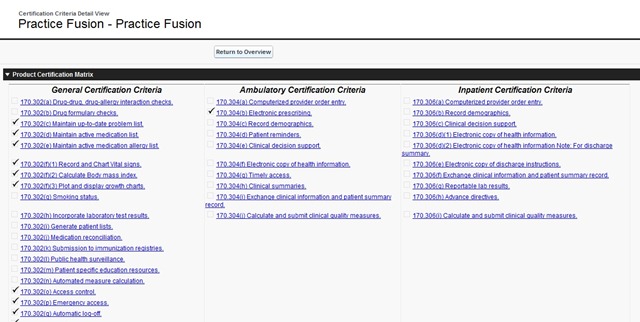
Practice Fusion, by the way, announces a partnership with Microsoft’s Windows Azure MarketPlace to offer researchers de-identified health information at no charge. The clinical dataset includes insights on vitals signs, diagnoses with ICD-9 codes, medications with NDC codes, prescription events, immunization details, and allergic reaction details. Practice Fusion also just obtained ONC-ATCB 2011/2012 Certification through Drummond Group.

PM/EHR vendor American Medical Software selects Intuit Health’s patient portal solution for its physician clients.

A CompTIA study suggests that 34% of healthcare providers are using comprehensive EHRs and more than half of all providers use some form of EMRs. I haven’t seen the actual study, but apparently the survey sample included only 300 healthcare “providers,” which included doctors, dentists, nurses, PAs, and office managers (who are clearly not “providers”, but I’ll let that slide). CompTIA also surveyed 370 IT firms, of which only 40% did business in the healthcare sector. In other words, the methodology sounds questionable and I’d be wary of adding these statistics to my next EHR white paper. If you have read the report and have a different opinion, please share.

inga

E-mail Inga.

From MGMA 10/27/10

October 27, 2010 News 3 Comments

Wednesday is officially the last day of the conference, but I am heading out bright and early.

I still have quite a few impressions to share, but I’ll start out by summarizing what I interpreted as the big buzzes this year:

  • Financial matters worry practice administrators the most. Declining reimbursement, healthcare reform, and rising costs are all contributing factors.
  • Hospitals are buying practices at a rate not seen for at least 20 years. Despite the failures back in the late 80s and early 90s, people are optimistic that alignment will work this time because physicians are tired of all the financial issues (see above) and evolving delivery models (ACOs) that support hospital ownership. Plus the new generation of physicians aren’t interested in working 80 hours a week and foregoing family life and other interests. These physicians are happy to work for a hospital for a guaranteed minimum paycheck.
  • Meaningful Use is defined and products are being certified, but EHR adoption is still not surging, though growth is steady. Practices, at the least the larger ones represented by MGMA members, are moving forward, but no one I met is rushing to be the first in town to qualify for federal monies.

014

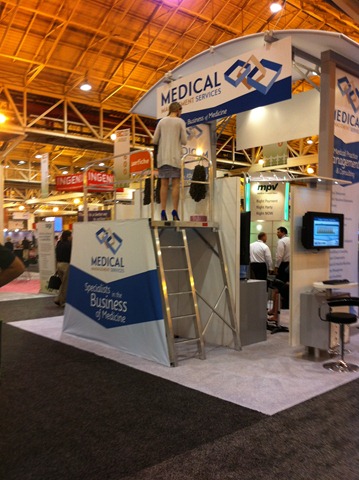
A reader suggested that maybe I should have thrown a shoe at the booth babe who pegged me in the head with beads on Sunday. With that in mind, I returned to the scene of the crime Tuesday. As you can see, Booth Babe is on a perch, giving her the ability to hurl the beads down onto the crowd. A nearby vendor told me that management banned her from throwing the beads into the aisle (which is how she pegged me). Instead, she had to sail the beads down to the people standing in the booth. A much more conservative, but far less dramatic approach. Anyway, all was forgiven after I noticed Booth Babe had on fabulous blue shoes.

001

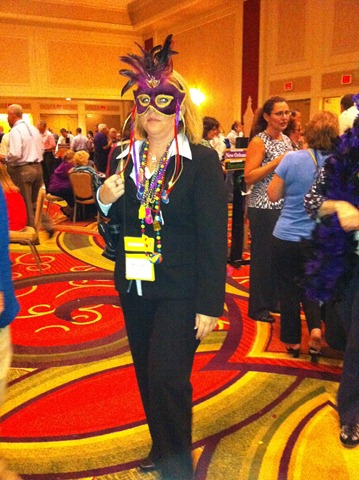
MGMA hosted a general reception Tuesday night. Many attendees took the opportunity to adorn themselves with Mardi Gras trinkets. The facility for this reception was smaller than the one used Sunday night. It also had fewer food and bar stations, which resulted in long lines. The MGMA people must have felt a little guilty about the wait since I noticed a couple of employees handing out free drink coupons. Free drinks always makes waiting more bearable.

True story: as I left my hotel room Tuesday morning, the maid told me she liked the shoes I had left in the room yesterday. In fact, she commented that the shoes were her size. A bit creepy, but she swore she didn’t try them on. Obviously I am not staying at the Ritz (I have a hard time believing the maids at the Ritz would admit to looking that closely to my shoes). But, I have to love a maid who knows her shoe fashions.

If you are planning a trip to a convention in New Orleans, here is a tip. The Marriott Convention Center is right across the street from the convention center. There is a different Marriott about half a mile away. If you are going to an event at “The Marriott,” it’s good to verify exact which Marriott before walking half a mile in fabulous, yet not particularly functional shoes. It also may save you $8 on cab fare as you rush to go to the “correct” Marriott.

And here is a tip for vendors: don’t ever tell a practice that has over four doctors that they are “small,” especially if the practice is located a small town. I witnessed that conversation and I think the administrator (who actually had an eight-doctor group) wanted to smack the vendor guy, or at least throw some beads at his head.

Many vendors threw private parties Monday night. Some of my invites must have gotten lost in e-mail, but thank you Sage and Allscripts for making sure I was included. I missed both those affairs, but the Allscripts people tell me they hosted about 500 people. Given there are only about 4,600 at the convention (including 2,700 paid attendees), I’d say Allscripts won the big party award.

Speaking of MGMA attendance, I heard the numbers are up about 30% from 2009. MGMA said they “ran out” of space in the exhibit hall (the total number of exhibitors was north of 250). I’ll take these as signs that the recession is easing a bit.

I chatted with the McKesson folks for awhile (who or may not have not gotten word about the company’s re-org, but were tight-lipped about any changes, nonetheless). Among other things, they told me about several Practice Partner clients who were successfully using McKesson tools for Medical Home initiatives. I had an even more telling conversation with an administrator who implemented the Practice Partner EHR in September and was pleased with the progress. She said she decided on Practice Partner because it worked well with her Lytec billing software (which does everything she needs it to do) and the price was right. Her practice had nine providers and NextGen’s proposal EHR was about $250,000. Glostream, which the doctors really liked, was almost $300,000. Practice Partner was about a third of the cost. She said that the Practice Partner software is perhaps not as pretty as the more expensive options, but, so far it is getting the job done and the doctors are pleased.

pet fax

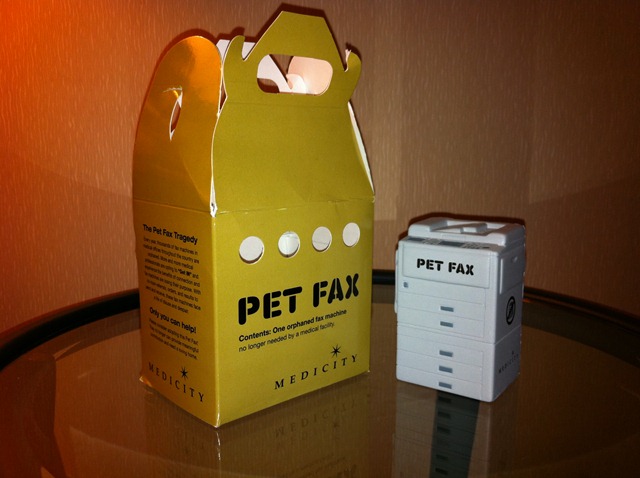
Medicity was showing off its new iNexx product, which is an open platform for health information exchange. Providers that are tied in can view clinical data from all connected providers. Medicity, along with third-party app developers, is creating additional modular applications. While I’m sure it could be deployed on a large scale, it seems like a great option for communities that are not ready for a full-blown HIE, yet want to share data. I believe the connection fee is $99 a month per provider. To promote the idea that iNexx can replace fax machines for data exchange, they were handing out “Pet Faxes.”  As an aside, Medicity told me this is the first time they have exhibited at MGMA and are pleasantly surprised by how many physician offices are already aware of their company.

In some of the larger sessions, rather than opening the floor for questions, participants were encouraged to text their questions. This seems like a great alternative to queuing up at microphones (or shouting out questions that have to be repeated) and then having people tell some long story before actually getting to the question. The text alternative meant the questions were shorter and to the point. Thumbs up.

I also was a fan of the Healthcare Innovations Pavilion, which was set up in the exhibit hall. Vendors had 20 minutes to overview a topic and of course make a pitch of some sort. A couple that I sat through included Meaningful Use (MED3OOO) and patient portals (Intuit). MGMA strategically scheduled these when there were breaks in the exhibit hall and they were standing room only. The presenters I heard were solid and I think people like hearing what vendors have to say without necessarily walking into a booth and asking questions.

004

Remnants from my last dinner in New Orleans. Yum.

Heading out to the airport momentarily. MGMA 2011 in Vegas!

inga

E-mail Inga.

Platinum Sponsors


Gold Sponsors


Subscribe to Updates


Search All HIStalk Sites


Recent Comments

  1. The article about Pediatric Associates in CA has a nugget with a potentially outsized impact: the implication that VFC vaccines…

  2. Re: Walmart Health: Just had a great dental visit this morning, which was preceded by helpful reminders from Epic, and…

  3. NextGen announcement on Rusty makes me wonder why he was asked to leave abruptly. Knowing him, I can think of…

  4. "New Haven, CT-based medical billing and patient communications startup Inbox Health..." What you're literally saying here is that the firm…

  5. RE: Josephine County Public Health department in Oregon administer COVID-19 vaccines to fellow stranded motorists. "Hey, you guys over there…