Recent Articles:

News 9/23/19

September 23, 2019 News Comments Off on News 9/23/19

Top News

image

App-based house call and telemedicine company Heal acquires New York City-based Doctors on Call for $15 million. The acquisition, Heal’s first, will enable it to tap into DoC’s Medicare clientele.


Webinars

September 26 (Thursday) 2 ET. “Patient Education Data: A Key Ingredient for Improving Quality and Patient Experience.” Sponsor: Healthwise. Presenters: Victoria L. Maisonneuve, MSN, RN, director of the Nursing Center for Excellence and Magnet program, Parkview Health; Marta Sylvia, MPH, senior manager of quality improvement and outcomes research, Healthwise. Healthcare data is everywhere! It’s scattered across various systems and in countless formats, making it difficult to collect and glean actionable information. Knowing where to start depends on what your organization wants to accomplish. By focusing on your patient education data, you can drive quality improvement across your organization. Vicki Maisonneuve will share how her team analyzes data around the use of patient education. By combining different data sets, she can easily identify trends, gaps, and opportunities to improve quality and patient experience across Parkview Health.

October 2 (Wednesday) 1:00 ET. “Conversational AI in Healthcare: What About ROI?” Sponsors: Orbita, Cognizant. Presenters: Kristi Ebong, SVP of strategy and GM of healthcare providers, Orbita; Matthew Smith, AVP and conversational AI practice leader, Cognizant. Conversational AI holds great promise to drive new opportunities for engaging consumers and customers across all industries. In healthcare, the stakes are high, especially as organizations explore opportunities to leverage this new digital channel to improve care while also reducing costs. The presenter experts offer a thought-provoking discussion around conversational AI’s timeline in healthcare, the factors that organizations should consider when thinking about virtual assistants through chatbots or voice, and the blind spots to avoid in investing in those technologies.

Previous webinars are on our YouTube channel. Contact Lorre to present your own.


Acquisitions, Funding, Business, and Stock

image

Tryon Medical Partners CEO Dale Owen says he fully expects to see employed physicians continue to break away from hospitals to form or join an independent practice. North Carolina-based Tryon, which was borne out of the exodus of several dozen physicians from Atrium Health, is working with a handful of MDs breaking away from CaroMont Health to form its first family practice expansion in the area. Owen insists, “The whole area is better served from a cost and value standpoint on the patients’ behalf if there are more independent doctors, rather than controlled referral patterns.”

image

Great Hill Partners sells behavioral health technology vendor Qualifacts to Warburg Pincus for an undisclosed sum. The majority investment will allow the company to focus on product development and sales and marketing efforts.


People

image

Ryan Anschuetz (Coverall North America) joins behavioral health EHR and practice management vendor Therapy Brands as VP of sales.

image image

E-consult software company RubiconMD names Sarah Alexander (Lumeris) COO and Fred Ronnau (CareAllies) CTO.


Announcements and Implementations

image

Compulink Healthcare Solutions announces GA of MyEyeStore, an online retail store and management system optometrists can add to their websites to generate new revenue streams.

image

Walmart Health implements Zotec’s RCM software at its new pilot clinic in Dallas, GA.

Symplast adds patient engagement and relationship management capabilities from Red Spot Interactive to its EHR and practice management software for plastic surgeons.


Telemedicine

image

MDCallU launches a membership-based telemedicine service for consumers powered by MDLive. A service like this seems like a perfect fit for those healthy, tech-savvy consumers looking for a way out of the traditional world of never-affordable insurance. Aside from the need to have some sort of policy that covers unforeseen issues (and hopefully prevents medical bankruptcy), I bet business models like this one become more popular in the coming months.


Other

image

I find it interesting that 23andMe is exhibiting at the AAFP’s Family Medicine Experience Conference this year. I can’t tell if they’ve exhibited before. The company plans to highlight “how our service works and how family doctors can help their patients use genetic information to make more informed decisions about their health.” I have to wonder how often family physicians field DNA testing questions from their patients, and how much misinformation they have to deal with. I’m also wondering if 23andMe is trying to lure physicians into selling their kits to patients. I’d love to hear from physicians who’ve had conversations with patients about the validity of consumer genetic testing results. Email me if you have stories to share, or if you’re attending FMX and spot anything our readers may find post-worthy.


Sponsor Updates

  • EClinicalWorks will exhibit at the AMA’s 2019 FMX September 25-27 in Philadelphia.
  • Madison Magazine names Nordic as the best place to work in Madison, WI.

Blog Posts


Contacts

Jenn, Mr. H, Lorre

More news: HIStalk.

Get HIStalk Practice updates.
Contact us online.
Become a sponsor.

News 9/18/19

September 18, 2019 News Comments Off on News 9/18/19

Top News

image

AI-powered clinical documentation company Robin Healthcare raises $11.5 million in Series A funding led by Norwest Venture Partners. The company’s Robin Assistant captures clinical notes through audio and optional video during an appointment, and then transmits them directly to a practice’s EHR.

The company’s executive team boasts experience at One Medical, Scribes STAT, and HonestHealth.


HIStalk Practice Musings

image

“Girl with a Pearl Earring” fans will be happy to know that Tracy Chevalier’s newest book, “A Single Thread” debuts this week. I spent a few minutes on her homegrown website and love that she plans to dress in a fashion similar to that of her 1930s heroine for the book’s launch in the nave of Winchester Cathedral, where the story takes place. As she enthuses at the end of her update, “Long live books!”

image

Hyland VP of Content Services Engineering David Luzier recommends “Dare to Lead” by Brené Brown in the company’s latest “What our execs are reading” blog.

I’d love to highlight what you, your colleagues, or book clubs are reading. Email me with your titles and I’ll be sure to share in an upcoming post.


Webinars

September 19 (Thursday) 2:00 ET. “ICD-10-CM 2020 Code Updates.” Sponsor: Intelligent Medical Objects. Presenters: June Bronnert, MSHI, RHIA, director of terminology mapping, IMO; Theresa Rihanek, MHA, RHIA, classification and intervention mapping lead, IMO; and Julie Glasgow, MD, senior clinical terminologist, IMO. The 2020 regulatory release is right around the corner. Join IMO’s top coding professionals and thought leaders as they discuss new, revised, and deleted codes; highlight revisions to ICD-10-CM index and tabular; discuss changes within Official Coding Guidelines; share potential impacts of the code set update; and review ICD-10-CM modifier changes.

September 26 (Thursday) 2 ET. “Patient Education Data: A Key Ingredient for Improving Quality and Patient Experience.” Sponsor: Healthwise. Presenters: Victoria L. Maisonneuve, MSN, RN, director of the Nursing Center for Excellence and Magnet program, Parkview Health; Marta Sylvia, MPH, senior manager of quality improvement and outcomes research, Healthwise. Healthcare data is everywhere! It’s scattered across various systems and in countless formats, making it difficult to collect and glean actionable information. Knowing where to start depends on what your organization wants to accomplish.  By focusing on your patient education data, you can drive quality improvement across your organization. Vicki Maisonneuve will share how her team analyzes data around the use of patient education. By combining different data sets, she can easily identify trends, gaps, and opportunities to improve quality and patient experience across Parkview Health.

October 2 (Wednesday) 1 ET. “Conversational AI in Healthcare: What About ROI?” Sponsors: Orbita, Cognizant. Presenters: Kristi Ebong, SVP of strategy and GM of healthcare providers, Orbita; Matthew Smith, AVP and conversational AI practice leader, Cognizant. Conversational AI holds great promise to drive new opportunities for engaging consumers and customers across all industries. In healthcare, the stakes are high, especially as organizations explore opportunities to leverage this new digital channel to improve care while also reducing costs. The presenter experts offer a thought-provoking discussion around conversational AI’s timeline in healthcare, the factors that organizations should consider when thinking about virtual assistants through chatbots or voice, and the blind spots to avoid in investing in those technologies.

Previous webinars are on our YouTube channel. Contact Lorre to present your own.


Acquisitions, Funding, Business, and Stock

image

Oncology-focused patient relationship management vendor Navigating Cancer raises $26 million in a Series D round of financing led by the Merck Global Health Innovation Fund and TT Capital Partners. The Seattle-based company will use the funding to make its technology more mobile-friendly, and develop population care capabilities enhanced by AI.


People

image

Athenahealth hires Luis Borgen (Vistaprint) as CFO.


Announcements and Implementations

image

Southwest Diagnostic Imaging Center in Dallas implements Royal Solutions Group’s Enterprise Care Management technology, which includes provider referral, patient intake, alerts, payment, and portal capabilities.

image

Nuances develops pediatric-specific versions of its clinical communication and documentation, and analytics software.

image

The Center Orthopedic & Neurosurgical Care (OR) implements an API that allows it to share data from its Allscripts EHR with PHR apps from MyLinks and Medlio.


Government and Politics

The Community HealthCare Association of the Dakotas and the Wyoming Primary Care Association will partner to create the Great Plains Health Data Network using a $1.56 million grant from HHS. Former DocuTap/Experity software engineer Kyle Mertens will head up development of the new network.


Telemedicine

image

The local paper profiles the work of the Medical Advocacy and Outreach clinic in Selma, AL. MOA serves HIV-positive patients through 10 telemedicine sites in central Alabama, and plans to expand to home-based care in the coming year. Its providers were initially skeptical of the virtual visit technology, but quickly realized its benefits: “In primary care, we touch the patient,” says Marguerite Barber-Owens, MD. “It was an adjustment for me. But then I saw the numbers. Selma has some of the most satisfied and [healthy] patients.” 


Other

image

The local paper reports that a clinic in Melbourne, Australia has been faxing the extremely detailed health information of at least 10 patients to the wrong person for nearly two years. The man on the receiving end of the misdirected faxes initially hoped the problem would stop of its own accord. He finally came forward after deciding the issue may be a systemic problem that could impact patient safety. Faxing, while an archaic practice to many, seems to be the preferred method for many providers down under. The delivery method came under scrutiny last year in Victoria when a cancer patient died alone in a hotel room – a situation that may have been avoided if test results indicating he needed immediate care hadn’t been faxed to the wrong number just days before.

image

Product designer Daniel Burka recounts Simple’s 17 month-long journey to building a no-fuss EHR for providers in India. The technology is focused on helping providers improve outcomes related to high blood pressure, can enable them to take blood pressure readings in 15 seconds. A favorite – and refreshing – snippet:

“AI, machine learning, and blockchain are all cool. But, it is a bit astonishing how often they come up in health tech discussions where ‘boring’ software will get the job done. What gets us excited is basic, well-built platforms, applied at scale to save lives.”


Sponsor Updates

  • AdvancedMD will exhibit at WebPT’s Ascend Conference September 19-21 in Minneapolis.

Blog Posts


Contacts

Jenn, Mr. H, Lorre

More news: HIStalk.

Get HIStalk Practice updates.
Contact us online.
Become a sponsor.
News 9/16/19

September 16, 2019 News Comments Off on News 9/16/19

Top News

image

Primary care startup Firefly Health raises $10 million in a Series A funding round led by F-Prime Capital and Oak HC/FT. the Wellesley, MA-based company offers concierge care to Massachusetts-based employers and health plan members at its clinic and on-site pop-up clinics, and through virtual consults or text-based messaging. It has developed a digital platform, Lucian, to connect with and care for patients before, during, and after their visits.

image

Former Athenahealth co-founder and CEO Jonathan Bush has joined the company as executive chairman.


HIStalk Practice Musings

image

Eric Topol, MD tweets his enthusiasm for Arthur Kleinman, MD’s new book, “The Soul of Care: The Moral Education of a Husband and a Doctor.” His take:

“I think Kleinman’s new book ‘The Soul of Care’ is one of the best in 2019. Some definitions of ‘care’ that he provides:

  1. Care is accompanying someone through their experience of alarm and injury. It is assisting, protecting thinking, ahead to prevent further difficulty.
  2. It is also the existential activity through which we most fully realize our humanity.
  3. The human glue that holds together families, communities and societies.
  4. Care can offer wisdom for the art of living.
    …..and many, many more

And I share his concern: ‘I believe we are living through a dangerous time when high-quality care is seriously threatened among families, in the health professions, in our hospitals & aged care homes, & in our society at large.” “sacrificed on the altar of economy and efficiency.’”

image

ChartLogic’s recent blog on maintaining proper etiquette in a physician practice reminded me of “The Emily Post Book of Etiquette for Young People” by Elizabeth Post. I picked up a copy of the now-vintage edition at my local Goodwill while in high school. Reading it helped me to understand that exhibiting good manners is simply a way of showing others they are worthy of our respect, time, and attention. In today’s world of patient satisfaction scores and high-tech patient engagement strategies, it seems that good manners might get lost in the world of high-tech, eyes-down healthcare. It should be the starting point, rather, for patient engagement strategies. As the blog says, “Maintaining proper etiquette throughout the day – even when times are tough – will help patients feel comfortable, trust your judgment, and ensure their loyalty to your practice.”

Perhaps its time for Post’s descendants to come out with an edition specific to healthcare settings. In the meantime, we’ll have to settle for “Manners in a Digital World” or “The Etiquette Advantage in Business.”


Webinars

September 19 (Thursday) 2:00 ET. “ICD-10-CM 2020 Code Updates.” Sponsor: Intelligent Medical Objects. Presenters: June Bronnert, MSHI, RHIA, director of terminology mapping, IMO; Theresa Rihanek, MHA, RHIA, classification and intervention mapping lead, IMO; and Julie Glasgow, MD, senior clinical terminologist, IMO. The 2020 regulatory release is right around the corner. Join IMO’s top coding professionals and thought leaders as they discuss new, revised, and deleted codes; highlight revisions to ICD-10-CM index and tabular; discuss changes within Official Coding Guidelines; share potential impacts of the code set update; and review ICD-10-CM modifier changes.

September 26 (Thursday) 2 ET. “Patient Education Data: A Key Ingredient for Improving Quality and Patient Experience.” Sponsor: Healthwise. Presenters: Victoria L. Maisonneuve, MSN, RN, director of the Nursing Center for Excellence and Magnet program, Parkview Health; Marta Sylvia, MPH, senior manager of quality improvement and outcomes research, Healthwise. Healthcare data is everywhere! It’s scattered across various systems and in countless formats, making it difficult to collect and glean actionable information. Knowing where to start depends on what your organization wants to accomplish.  By focusing on your patient education data, you can drive quality improvement across your organization. Vicki Maisonneuve will share how her team analyzes data around the use of patient education. By combining different data sets, she can easily identify trends, gaps, and opportunities to improve quality and patient experience across Parkview Health.

Previous webinars are on our YouTube channel. Contact Lorre to present your own.


Acquisitions, Funding, Business, and Stock

Seven family practice physicians sue CaroMont Health in North Carolina after the health system insists on a restrictive non-compete clause and refuses to let them out of their contracts without paying a $1.8 million. The doctors want to leave and form a practice as part of Tryon Medical Group, which formed last year after several physicians sued to break away from Atrium Health. The physicians claim they want to leave CaroMont because of frustrations with the “bureaucratic red tape of hospital administration.”


Announcements and Implementations

image

DrChrono puts all of its Ipad-based EHR and practice management features onto its Iphone app.

image

Eccovia Solutions adds an SDOH screening tool to its ClientTrack care coordination software.


People

image

Patient engagement company Health Monitor Network names William Saint-Louis (Regalis Health Services) CTO and promotes Alex Dong to EVP.


Research and Innovation

image

Google develops a deep learning system to help primary care physicians improve diagnostic accuracy of skin conditions. An initial study found that its DLS helped PCPs diagnose skin conditions across 26 categories with accuracy similar to that of dermatologists.


Other

image

Construction of the Google-backed OneFifteen addiction treatment center continues in Dayton, OH. Development of the center, part of a campus of tech-enabled recovery and social services launched by Kettering Health Network, Premier Health, and Verily, was originally scheduled to open in June. Construction delays have pushed the start of patient care back to October.


Sponsor Updates

  • EClinicalWorks will exhibit at Health 2.0 September 16-18 in Santa Clara, CA.
  • Intelligent Medical Objects will exhibit at AHIMA September 14-18 in Chicago.

Blog Posts


Contacts

Jenn, Mr. H, Lorre

More news: HIStalk.

Get HIStalk Practice updates.
Contact us online.
Become a sponsor.

News 9/11/19

September 11, 2019 News Comments Off on News 9/11/19

Top News

image

Women’s healthcare company Kindbody opens its fourth – and largest – clinic in Flatiron, NY. The company launched just over a year ago, has raised $22 million, and developed its own EHR. Digital health offerings also include virtual consults and a patient portal. It plans to open three more clinics by the end of 2019.

image

Founder and CEO Gina Bartasi’s path to women’s wellness seems to have started at an Atlanta-based publishing company, progressed to the founding of a content-driven fertility-focused website, and then led to her founding fertility benefits company Progyny, which she left in 2017.


HIStalk Practice Musings

image image

Fans of Margaret Atwood will be happy to know that “The Testaments,” her sequel to “The Handmaid’s Tale,” is now available. I remember liking the first book, but it’s been so long that I’ll need to read it again before attempting the second. I haven’t seen the show on Hulu, which has already acquired the rights to the sequel.

Goodreads has compiled this list of highly anticipated novels set to come out this fall. I’m especially excited about “The Starless Sea” by Erin Morgenstern, who wrote the fantastic “The Night Circus.” (If you read one book this year, make that one it.) I’m also going to check out “The Giver of Stars” by Jojo Moyes, which tells the story of a woman who joins a traveling library started by Eleanor Roosevelt.

image

And speaking of libraries, efforts have been underway for some time now to convert Britain’s 10,000 remaining phone boxes for other more relevant uses. Some communities have turned them into micro libraries through sponsorship programs, while others have used them to house defibrillators.


Webinars

September 19 (Thursday) 2:00 ET. “ICD-10-CM 2020 Code Updates.” Sponsor: Intelligent Medical Objects. Presenters: June Bronnert, MSHI, RHIA, director of terminology mapping, IMO; Theresa Rihanek, MHA, RHIA, classification and intervention mapping lead, IMO; and Julie Glasgow, MD, senior clinical terminologist, IMO. The 2020 regulatory release is right around the corner. Join IMO’s top coding professionals and thought leaders as they discuss new, revised, and deleted codes; highlight revisions to ICD-10-CM index and tabular; discuss changes within Official Coding Guidelines; share potential impacts of the code set update; and review ICD-10-CM modifier changes.

September 26 (Thursday) 2 ET. “Patient Education Data: A Key Ingredient for Improving Quality and Patient Experience.” Sponsor: Healthwise. Presenters: Victoria L. Maisonneuve, MSN, RN, director of the Nursing Center for Excellence and Magnet program, Parkview Health; Marta Sylvia, MPH, senior manager of quality improvement and outcomes research, Healthwise. Healthcare data is everywhere! It’s scattered across various systems and in countless formats, making it difficult to collect and glean actionable information. Knowing where to start depends on what your organization wants to accomplish. Vicki Maisonneuve will share how her team analyzes data around the use of patient education. By combining different data sets, she can easily identify trends, gaps, and opportunities to improve quality and patient experience across Parkview Health.

Previous webinars are on our YouTube channel. Contact Lorre to present your own.


People

image image

Doctor on Demand names Robin Glass (Evolent Health) president and chief commercial officer, and David Deane (TurningPoint Healthcare Solutions) VP of business development.


Announcements and Implementations

image

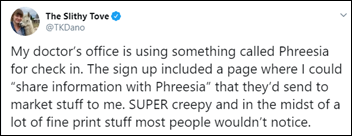
North Carolina Department of Health and Human Services providers will use Phreesia intake technology to deliver the state’s Standardized Social Determinants of Health Screening Questions to patients and alert providers in real time to available resources. The SDOH screening is part of the state’s Health Opportunities initiative, which will also coordinate care between state-based agencies using the NCCare360 data-sharing network.


Telemedicine

image

MTBC makes virtual consult capabilities available to select behavioral health and addiction medicine specialists using its TalkEHR. It plans to make the feature available to all customers by the end of the year.

image

Symplast adds telemedicine features to its EHR and practice management software for plastic surgery and medspa providers.

image

Aunt Martha’s Health & Wellness, an FQHC with 23 clinics in and around Chicago, will use a $136,000 grant from HHS to offer primary care and diabetes management via telemedicine. It will also offer diabetic patients an app that will allow them to record and share their daily sugar levels with providers.


Other

image

This article highlights the vast differences consumers find when they check prescription prices using GoodRx. It’s true that pricing for the same drug can vary in the extreme, making it well worth a consumer’s while to trek a few extra miles to save money. The Byzantine nature of prescription drug pricing was made all too clear to me last week, when I had to fill several prescriptions for myself and a family member. Being a cash-paying customer, I transferred the first prescription from Walgreens, where GoodRx listed it as $25, to Publix, which listed it as $12. The fact that the two establishments were across the street from each other made the decision that much easier. I discovered, much to my chagrin, that Publix doesn’t accept GoodRx coupons, but was happy to apply some sort of magical discount to my total, bringing the prescription’s price down to $5. While I didn’t leverage GoodRx’s coupons for any of the medications, browsing the site certainly made me more aware of the need to shop around and ask my provider and pharmacist questions about pricing. In fact, I did just what GoodRx Director of Research Thomas Goetz predicted I would: “When … transparency is in the hands of consumers, consumers start to change behavior. And that starts to change the economics of the system. It’s very slow-going, but that’s in general what we’re all about.”


Contacts

Jenn, Mr. H, Lorre

More news: HIStalk.

Get HIStalk Practice updates.
Contact us online.
Become a sponsor.

From the Consultant’s Corner 9/11/19

September 11, 2019 From the Consultant's Corner Comments Off on From the Consultant’s Corner 9/11/19

Patient Access: Partnering with Clinicians is Essential for Success
By Nancy Gagliano, MD

image

Nancy Gagliano, MD is CMO at Culbert Healthcare Solutions in Woburn, MA.

Providers and clinical practices are being persuaded to transition patient access responsibilities to a central patient access center. This comes with the promise of removing administrative burdens for patient scheduling, registration, and more; thus, the practice can focus solely on delivery of care. Patient access center set-up typically transfers existing patient service representatives to a centralized unit, which is organized around pods of specialty expertise. This strategy provides for knowledge transfer to the central unit and a personal link back to the practice. However, in a blink, providers express frustration with scheduling errors and patient complaints. To compound the problem, central staff turnover of around 30% leads to the loss of personal linkages and knowledge transfer.

There are many factors that contribute to an underperforming central access approach, such as inadequate technology and its set up, insufficient and undertrained staff, as well as ineffective management structure. However, complexity of provider scheduling is often an underlying factor severely limiting the potential for success. Organizations often lack standards for provider schedules, visit time, visit types, and protocols. This article provides guidance for an organizational approach to provider scheduling and a partnership between practices and centralized access centers.

We’ve all heard the reasons for complex schedules:

  • I need seven minutes for a visit.
  • I need 15 minutes for a visit.
  • My patients are sicker.
  • I shouldn’t waste my valuable expertise outside of my sub-specialty.
  • I can only see two – “wellness, consults, annuals, new” in a session.
  • My sessions should be three hours.
  • My session should be five hours with only 1 new patient.

On top of the scheduling complexity is the “provider bump.” Somehow, conferences, vacations, and car registrations happen at the last minute and patients need to be rescheduled. Altogether, these factors result in gaps in schedules, wrong patients in slots, frequent rescheduling, and unhappy patients and providers.

As a physician, I have frequently seen these challenges, and do not blame the providers. They are trying to bring structure to their chaotic lives in a healthcare world that continues to place more and more burden on them. With long and often unpredictable hours, remembering to submit time-off requests for conferences or to tend to an expired car registration falls to the bottom of their priority lists. Therefore, it is the organization’s responsibility to help provide structure and clear expectations to reduce the chaos.

Time slots

While individual providers have a good sense of how long it typically takes them to see each type of patient, it is extremely challenging for a scheduler to know exactly what type of patient or condition they are scheduling, which often results in placing the patient in the wrong time slot. Additionally, complex schedules will often leave gaps unfilled. If a provider’s schedule has an open 15-minute urgent care slot at 9 am and a 15-minute routine at 11 am, how can a scheduler book a patient requiring a half-hour appointment? When located within an office, a quick chat can provide approval to overbook a timeslot or merge two disparate slots, but a patient access rep often doesn’t have easy access to the practice. Instead of contacting the practice to get authority to adjust a visit type, slots go unfilled. Multiply this by hundreds of providers with their unique scheduling requirements, and it is understandable that scheduling errors occur, and that access is not optimized.

One of the most important endeavors taken by an organization to improve this problem is to establish organization-wide visit-time standards – if not at the organizational level, then at least at each practice level. Our favorite is 20, 40, or 60 minutes per appointment. All patient visit types fit into one of these three-time allotments. The chance of making an error is dramatically reduced, as is the potential for unfilled gaps in the schedule. For providers who see patients faster than this, their schedules can have a few double-booked slots built in, and those providers who take longer have a couple of 20-minute blocks dispersed through their day.

Providers often need some convincing to accept this new template. We advise starting with the total number of patients they currently see during their session and creating the template based on the total volume. Highlight that the patient flow will even out over the day, even if a few patients take longer or shorter than the 20 minutes they were booked for. The result will be far fewer patients booked in incorrect slots and an overall smoother patient flow. As the provider adjusts to the new schedule, blocks or double bookings can be added to further accommodate the provider’s style. To gain provider acceptance, it is important not to initially expect increased provider productivity, but rather reduced scheduling errors and smoother patient flow.

Templates

Scheduling templates are helpful to create a balance of appointment types each day, such as new, annual, follow-up, and urgent. We commonly see two challenges with template approaches. The first is that they are set up with numerous types of appointments, creating rigidity and confusion for the schedulers. Once again this leads to errors. The second is that they are often built on provider choice rather than demand. For example, a provider wants to only see two annual exams daily, but has a panel size requiring four annuals. This results in a cascade of patients put in “wrong” visit types; lack of same day/urgent visits; and frustrated schedulers, providers, and patients.

We recommend an analytic approach to building templates — analyze historic volume, current practice challenges, and build as flexible a template as possible. In addition, while holding slots for certain visit types may be important, such as setting aside new consults, make sure you have a process to unfreeze slots in a suitable time frame for them to be used for other patient needs. For example, many sub-specialists are reluctant to see more general specialty patients, while a health system may have unmet general specialty demand. It may be an appropriate compromise to hold new patient slots for specific disease conditions until three to five days before the date and then open to more general new patients after that.

Protocols

Another common challenge is scheduling protocols that are either too vague or too complex. For example, “back pain” could end up with an orthopedic surgeon, rheumatologist, physical therapist, or primary care provider. The process may not easily facilitate the scheduler matching the patient to the right provider. On the other hand, if the criteria for scheduling is so complex that medical education is needed to decipher it, it may not be appropriate for routine centralized patient access center to schedule. Adding additional clinical staff, or enhanced technology, may be needed for sub-specialty activities. With the right resources to liaison between the practices and central scheduling unit, a middle-ground approach can be devised. It is important to review and develop a formal protocol review process and bring significant variations to the governance body.

Provider Time

Another important component of a successful centralized patient access approach is having provider schedules available for a minimum of six months, and preferably one year out. For this to work, however, call schedules, vacations, and conferences need to be planned and set in advance. A common practice requires providers to submit their time off requests every six to 12 months. With advanced planning, almost all requests can be accommodated. Any additional time-off requests should require practice/department leadership approval. Additionally, finding one’s own coverage and making up the time-off quickly for last minute emergencies should be a standard expectation.

Communication

Whether it’s provider schedules, protocols, or complex patients, there are numerous needs for good communication between the call center and the practices. It is important to have a clear process and expectation for communication. This could be anything from a “back line phone” between the practice and the call center, to a formal liaison relationship. Setting the foundation for a partnership approach requires excellent communication and process to solve problems.

Governance

This all leads to the need for organizational governance. This should include providers, practice management, central access leadership, and IT. Too often, patient access oversight is limited to the operations side of the healthcare system. The clinicians voice their concerns to health system leadership while feeling frustrated and powerless. Health system leadership turns to the central access leaders and demands improvement in accuracy and patient service. All the while, the access center leadership is frustrated by their inability to influence the practices to support their needs. A dyad governance approach is essential for a successful centralized patient access. Both operations and clinical practice representation is essential. It is crucial to develop organizational standards for provider scheduling for everything from visit type, visit length, provider bump rules, to scheduling protocols. In return, the access center should be held accountable for Service Level Agreements, such as abandonment rate, speed to answer, handle time, and accuracy.

In summary, it is unlikely for a centralized patient access approach to be successful without a partnership between centralized patient access and clinical practices. While providers often bristle at standardization, once implemented, providers usually see fewer errors and smoother scheduling. Setting performance expectations of the central access center, as well as implementing scheduling standards, is foundational for a high-performing central access approach. Therefore, creating a dyad governance approach can create both the alignment and the accountability for a successful partnership.


Contacts

Jenn, Mr. H, Lorre

More news: HIStalk.

Get HIStalk Practice updates.
Contact us online.
Become a sponsor.

Platinum Sponsors


Gold Sponsors


Subscribe to Updates


Search All HIStalk Sites


Recent Comments

  1. The article about Pediatric Associates in CA has a nugget with a potentially outsized impact: the implication that VFC vaccines…
  2. Re: Walmart Health: Just had a great dental visit this morning, which was preceded by helpful reminders from Epic, and…

  3. NextGen announcement on Rusty makes me wonder why he was asked to leave abruptly. Knowing him, I can think of…

  4. "New Haven, CT-based medical billing and patient communications startup Inbox Health..." What you're literally saying here is that the firm…

  5. RE: Josephine County Public Health department in Oregon administer COVID-19 vaccines to fellow stranded motorists. "Hey, you guys over there…