March 20, 2016NewsComments Off on Population Health Management Weekly Wrap Up 3/20/16
Deerwalk promotes Scott MacEwen to senior vice president of client strategies.
Caradigm forms a Care Transformation Team of clinical experts led by Vice President Vicki Harter to guide providers in how to best align their care delivery needs to the appropriate Caradigm solutions. The new team will also assist in identifying internal processes in need of optimization for population health initiatives.
Aegis Health Group promotes Rochell Pierce to senior vice president of market development and Yale Miller to client solutions principal.
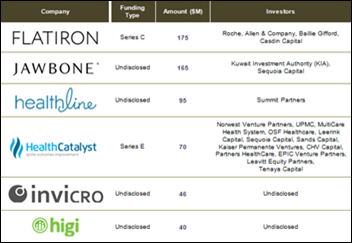
Predictive analytics care coordination systems vendor Pieces Technologies raises $21.6 million in Series A funding. Lt. Dan digs into the details at HIStalk Connect.
Beaver Manufacturing selects population health management services from Healthcare Interactive. The Mansfield, GA-based company will next month begin rolling out a smoking cessation program, onsite and phone-based health coaching, wellness program incentives and rewards, analytics and real-time reporting, and a technology platform that integrates everything.
The local radio station covers the Municipal Health Data for Cities Initiative, a collaboration between New York University and the National Resource Network that is working to aggregate data around the concerns of city leaders, including alcohol and drug addiction, lack of access to healthy food, chronic disease, and lead exposure. The initiative, which aims to help cities improve health outcomes, will launch a dashboard this September with data from four pilot cities – Kansas City, KS; Flint, MI; Providence, RI; and Waco, TX.
A ProPublica analysis of physicians who have written at least 1,000 prescriptions in Medicare Part D finds that those who received money from drug and device makers prescribed a higher overall number of name-brand drugs than physicians who didn’t. Even physicians who were just treated to meals prescribed more. The analysts don’t go so far as to assume a direct cause and effect; instead, they point out that “payments are associated with an approach to prescribing that, writ large, benefits drug companies’ bottom line.” American College of Cardiology President Kim Williams, MD points out in accompanying NPR commentary that relationships between companies and physicians are circular. “The more physicians learn about a new drug’s differentiating characteristics, the more likely they are to prescribe it,” he explained. “And the more they prescribe it, the more likely they are to be selected as speakers and consultants for the company.” It seems to be a very slippery – and subjective – slope. I’m hoping Dr. Jayne will weigh in.
Webinars
March 22 (Tuesday) 2:00 ET. “Six Communication Best Practices for Reducing Readmissions and Capturing TCM Revenue.” Sponsored by West Healthcare Practice. Presenters: Chuck Hayes, VP of product management, West; Fonda Narke, senior director of healthcare product integration, West Healthcare Practice. Medicare payments for Transition Care Management (TCM) can not only reduce your exposure to hospital readmission penalties and improve patient outcomes, but also provide an important source of revenue in an era of shrinking reimbursements. Attendees will learn about the impacts of readmission penalties on the bottom line, how to estimate potential TCM revenue, as well as discover strategies for balancing automated patient communications with the clinical human touch to optimize clinical, financial, and operational outcomes. Don’t be caught on the sidelines as others close gaps in their 30-day post discharge programs.
Contact Lorre for webinar services. Past webinars are on our HIStalk webinars YouTube channel.
Acquisitions. Funding, Business, and Stock
Value-added reseller Azcomp Technologies voices its support for the sale of McKesson’s ambulatory products to E-MDs, a business that it considers to be “smaller and more focused on servicing the type of medical practices and physician’s offices that have been the primary customers of Azcomp.” In addition to McKesson software, the Mesa, AZ-based VAR also sells Lytec PM software, to which it anticipates adding mobile diagnosis and billing entry features in the near future.
Colorado Permanente Medical Group partners with Boulder, CO-based accelerator Boomtown to introduce its first healthcare class. Mindful Labs, Patientory, VisibleHand, and Agathos will go through a 12-week mentoring program culminating in a demo day on April 13. I’m most interested in Agathos, which is developing a tool to provide physicians with insight into treatment costs, prognosis and treatment results culled from peers, performance statistics, and peer evaluations.
Announcements and Implementations
Millenium Healthcare launches a chronic care management service that it hopes to roll out to at least 100 physician practices in 2016. Millenium is parent company to four subsidiaries that specialize in billing and coding, medical devices, clinical laboratory, and messaging services.
East Tennessee Health Information Network selects real-time, healthcare data management and reporting technologies from Imat Solutions. ETHIN anticipates full implementation of Imat’s software to be wrapped by the end of June. Imat signed a similar deal with Delaware Health Information Network last June.
Research and Innovation
An American Journal of Managed Care study of practices acquired by hospitals finds no difference in healthcare IT utilization – in other words, a practice bought up by a hospital is no more likely to implement a new EHR than one that retains its independence. The study did find significantly higher usage of evidence-based care-management processes across hospital-owned practices of all sizes, likely due to greater availability of resources as a result of acquisition. The authors conclude that hospital-owned practices may be a better bet for chronically ill patients.
Fitbit users can now ask Amazon’s Alexa voice assistant about their sleep patterns, daily walks, and other monitored health activities. Alexa, which is compatible with Amazon’s Echo speaker and Fire TV streaming devices, may even offer words of encouragement like, “I believe in you.” Fitbit goals are more likely to be met if Alexa were to say, “You shouldn’t lay on the couch you lazy bum. You’re 5,000 steps short of your daily goal.”
Other
AMA throws its support behind the AllTrials initiative, a global campaign that is working to increase awareness of a greater need for clinical trials transparency. “The AMA strongly supports improving the timeliness and accessibility of clinical trial data to reduce the duplication of research and help inform future research — ultimately improving health outcomes for patients,” says AMA President Steven J. Stack. “The AMA is pleased to join the AllTrials initiative to continue efforts aimed at ensuring open access to clinical trial data for physicians, researchers and patients.”
March 17, 2016NewsComments Off on Readers Write: Balancing the Population Health Management Equation
Balancing the Population Health Management Equation By Tamara StClaire
The increased accountability of healthcare providers was discussed at length during HIMSS 2016; they need to show improvements to the overall health of the patients they serve or face stiff financial penalties. Indeed, “value-based care” is not an option, but a mandate: CMS will require at least 50 percent of payments be value-based by 2018.
We’re hearing from providers that they are nervous about that requirement, and for good reason. Value-based contracts currently make up less than 10 percent of the portfolios of many providers and payers, according to research from Xerox – that illustrates a long journey ahead.
As readers of this HIStalk Practice are likely aware, population health management programs are not a new concept, but providers are increasingly turning toward them in order to make the jump. Information technology plays a big role in population health management efforts. Most begin with aggregating data from a wide variety of sources, such as medical claims, EHRs, patient portals – and yes, even mobile applications and wearables. Data analytics also helps develop attribution models, segment populations, and improve our understanding of specific groups of patients. Intervention programs, complete with feedback loops for optimization, are ultimately designed and developed with the help of advanced information technology.
Too often, the solution stops here – but that’s only half of the puzzle. As my friend Geeta Nayyar, MD chief healthcare and innovation officer for Femwell Group Health, stated at a roundtable discussion at HIMSS, “Technology plus people is the best formula for population health management success.”
Sometimes we forget about the second half of that formula. What really makes a difference and makes it possible to improve the health of diverse patient populations and reduce costly interventions is the ability to turn data into meaningful, actionable information with timely execution of necessary programs. For example, technology makes it possible to analyze populations and segment at-risk groups of individuals. But it’s equally important for “health coaches” to have numerous touch points with those at-risk patients and provide specific instruction on how to stay healthy or remind them to take important medication. Even administrative services like appointment scheduling and patient onboarding improves levels of patient literacy and engagement, resulting in a direct and clear impact on the bottom line.
It’s important to remember that technology should support people and processes – not the other way around.
If we can master both sides of the equation, we’ll end up with healthcare delivery that improves outcomes. Population health management solutions can help providers make the leap to value-based care and achieve an era of more accessible care with lower costs and healthier patients.
Tamara StClaire is chief innovation officer for Xerox Healthcare Business Group.
HHS announces the members of its Health Care Industry Cyber Security Task Force. Names that catch my eye include CISOs from Anthem, Merck, Sutter Health, and Cook Children’s Health Care System. The 22-member task force will meet four times this year, and will work to develop and submit a report on improving cybersecurity to Congress before it disbands in March 2017.
Webinars
March 22 (Tuesday) 2:00 ET. “Six Communication Best Practices for Reducing Readmissions and Capturing TCM Revenue.” Sponsored by West Healthcare Practice. Presenters: Chuck Hayes, VP of product management, West; Fonda Narke, senior director of healthcare product integration, West Healthcare Practice. Medicare payments for Transition Care Management (TCM) can not only reduce your exposure to hospital readmission penalties and improve patient outcomes, but also provide an important source of revenue in an era of shrinking reimbursements. Attendees will learn about the impacts of readmission penalties on the bottom line, how to estimate potential TCM revenue, as well as discover strategies for balancing automated patient communications with the clinical human touch to optimize clinical, financial, and operational outcomes. Don’t be caught on the sidelines as others close gaps in their 30-day post discharge programs.
Contact Lorre for webinar services. Past webinars are on our HIStalk webinars YouTube channel.
Check out the Twitter recap of today’s HIStalk webinar featuring Children’s Hospital of Colorado’s journey with communications technologies from Spok. One of my favorite observations from CTO Andrew Blackmon: “We had so many devices we joked that we needed suspenders so scrubs wouldn’t fall down.”
Acquisitions, Funding, Business, and Stock
Management consulting firm Oliver Wyman predicts at least $200 billion of current healthcare spending will flow into alternative sites of care like retail clinics, urgent care centers, and telemedicine providers. The global company’s prediction stems from recent research that shows a sizeable uptick in consumer awareness and utilization of these services. Nearly 80 percent of those surveyed found care at an alternative site to be the same or better than a traditional physician’s office, proving once again that practices need to be on high alert when it comes to marketing and patient engagement in between appointments.
People
The Pennsylvania EHealth Partnership Authority promotes Kay Shaffer to certification, compliance, and privacy officer.
Telemedicine
Atlantic Spine Center (NJ and NY) launches virtual consultations. The new service also gives patients the ability to upload X-rays, MRIs, and CT scans for review by ASC physicians.
Government and Politics
Thirty-four provider organizations, including the American Academy of Family Physicians, American College of Physicians, MGMA, and the National Rural Health Association, write to Acting CMS Administrator Andy Slavitt asking for the return of the 90-day reporting period in 2016. The organizations stress that “announcing this as soon as possible will reduce the number of providers who will feel compelled to rely on filing for a hardship.”
Research and Innovation
San Francisco-based startup AliveCor is developing a heart-monitoring sensor for the Apple Watch. The sensor, which is awaiting FDA approval, will be accompanied by a speech-recognition app that generates real-time heart-rate analysis from users voicing their symptoms and touching the sensor, which snaps onto the back of the Watch. The app also lets users email their analyses to physicians. AliveCor CEO CEO Vic Gundotra, a former Google executive, is confident the app “will become the first FDA-cleared accessory for any smartwatch device.”
Dutch researchers conclude that disruptive patients do indeed affect a physician’s ability to make an accurate diagnosis. The study of 63 family practice residents found that their diagnostic accuracy suffered when dealing with disruptive patients, though “deliberate reflection” after the initial diagnosis helped to improve that accuracy. A patient’s “likability” also had no bearing on the amount of time a physician was willing to spend with them – disruptive patients were afforded just as much as non-disruptive ones. It would be interesting to conduct a similar survey with EHRs thrown into the mix. Would disruptive patients combined with too many clicks cause diagnostic errors?
Other
Patient Safety Week is in full swing. Sponsored by the National Patient Safety Foundation, the campaign seeks to raise awareness about safety issues in all healthcare settings. Providers and consumers can also take a pledge to “stand united in striving to reduce harm in patient care,” which also entails reading the foundation’s Free From Harm Report and hosting a related discussion group with staff.
Sponsor Updates
GE Healthcare CEO John Flannery outlines his plans for company growth in the local business paper.
GE Healthcare join The Patient Safety Movement’s Open Data Pledge.
HealthSpot holds a fire sale, putting all of its assets up for purchase after declaring bankruptcy in February. The health kiosk company generated $600,000 in revenue in 2015, up from $223 in 2014, and shut its doors with $5.17 million in assets and $23 million in liabilities. Companies such as Cox Communications and Xerox – two of HealthSpot’s largest investors – are among the 20 that have expressed interest in acquiring the now-defunct company’s 190 telemedicine booths and software. Xerox’s interest jives with what Chief Innovation Officer of Commercial Healthcare Tamara StClaire told me at HIMSS. She equated Xerox’s former partnership with HealthSpot as a learning lesson – one that has left the company now fully committed to remaining in the telemedicine space with an eye towards offering virtual queuing and payment processing. She wouldn’t name names, but did say that the company is in talks with several telemedicine vendors to prop up their IT infrastructure in the coming months.
Webinars
March 16 (Wednesday) noon ET. “Looking at the Big Picture for Strategic Communications at Children’s Hospital Colorado.” Sponsored by Spok. Presenters: Andrew Blackmon, CTO, Children’s Hospital Colorado; Hemant Goel, president, Spok. Children’s Hospital Colorado enhanced its care delivery by moving patient requests, critical code communications, on-call scheduling, and secure texting to a single mobile device platform. The hospital’s CTO will describe the results, the lessons learned in creating a big-picture communication strategy that improves workflows, and its plans for the future.
March 16 (Wednesday) noon ET. “The Physiology of Electronic Fetal Monitoring.” Sponsored by PeriGen. Presenter: Emily Hamilton, MDCM, SVP of clinical research, PeriGen. This webinar will review the physiology of EFM – the essentials of how the fetal heart reacts to labor. The intended audience is clinicians looking to understand the underlying principles of EFM to enhance interpretation of fetal heart rate tracings.
March 22 (Tuesday) 2:00 ET. “Six Communication Best Practices for Reducing Readmissions and Capturing TCM Revenue.” Sponsored by West Healthcare Practice. Presenters: Chuck Hayes, VP of product management, West; Fonda Narke, senior director of healthcare product integration, West Healthcare Practice. Medicare payments for Transition Care Management (TCM) can not only reduce your exposure to hospital readmission penalties and improve patient outcomes, but also provide an important source of revenue in an era of shrinking reimbursements. Attendees will learn about the impacts of readmission penalties on the bottom line, how to estimate potential TCM revenue, as well as discover strategies for balancing automated patient communications with the clinical human touch to optimize clinical, financial, and operational outcomes. Don’t be caught on the sidelines as others close gaps in their 30-day post discharge programs.
Announcements and Implementations
St. Clair Specialty Physicians (MI) completes its enterprise-wide implementation of MD Coder Dialysis charge-capture software from Medical Design Technologies.
Morris Heights Health Center (NY) implements EHR and population health management software from EClinicalWorks across its eight locations and 200 physicians. Included in the roll out is a patient portal and accompanying Healow smartphone app.
Airrosti selects PatientPay’s paperless billing solution and TransFirst’s healthcare payment processing services. The five-state chain of physical therapy centers is one of the first companies to take advantage of combined TransFirst-PatientPay offerings, the result of a strategic alliance announced last year.
Flatiron Health embeds Via Oncology’s evidence-based Pathways decision-support tools for eight types of tumors into its OncoEMR software. Pathways for additional types of tumors will be added later in the year.
People
Charles Koontz (Computer Sciences Corp.) joins GE Healthcare as president and CEO of GE Healthcare IT, and GE Healthcare Chief Digital Officer.
Government and Politics
ONC releases a final report on the State HIE Program, established via $564 million in HITECH Act funding to rapidly establish HIEs across the country. The 14-page report outlines program planning, implementation, operation, lessons learned, challenges (interoperability, funding, and sustainability), and impact. Fun fact: The report’s list of abbreviations includes a whopping 63 acronyms and their descriptions.
Telemedicine
Independence Blue Cross in Southeastern Pennsylvania begins offering telemedicine coverage. Members can take advantage of employer-sponsored virtual consults through MDLive, or through their local primary care physician.
24/7 Kid Doc signs a three-year agreement with 24/7 Pediatric Care Centers to supply on-call practitioners to meet expected demand as Kid Doc launches and expands its telemedicine services into school districts across the country.
Research and Innovation
A study in JAMA Internal Medicine finds that primary care physicians receive nearly 77 notifications daily from their EHRs, and that specialists receive close to 30. Researchers conclude that the average PCP spends at least 1 hour each day – uncompensated – managing their EHR inbox instead of making eye contact with patients. They add that, “[I]nbox notification capabilities should be periodically reviewed to be sure that this component of the EHR is working in the best interests of patient care and not creating an unnecessary burden on physicians.”
Other
AHRQ tailors its TeamStepps program to physician practices, offering practice leaders tools and resources to help them with quality improvement and practice transformation endeavors. TeamStepps for Office-Based Care is available as a classroom, online, or hybrid course.
Physicians looking to cope with burnout may want to attend The American Meditation Institute’s annual mind/body medicine conference October 25-29 in Lenox, MA. Physicians have a chance to earn 30 CME credit hours, courtesy of accreditation through the Albany Medical College Office of Continuing Medical Education. Conference curriculum will include mantra meditation, easy-gentle yoga, yoga psychology, nutrition, and functional medicine.
The article about Pediatric Associates in CA has a nugget with a potentially outsized impact: the implication that VFC vaccines…