Everybody’s Talkin’ Telemedicine
By Janet Munro, CEO, Mehealth
From the corridors of power, where talk is of the Telehealth Parity Act, to the drugstore on the corner, with CVS Health reporting patient satisfaction rates topping 90 percent in its huge telemedicine pilot, everybody’s talking about telemedicine.
But does it work? Yes. Over 40 years of publications demonstrate that telemedicine saves money for patients, providers and payers; improves care; and yields high levels of patient satisfaction.
Here’s an example. There is a problem in pediatric ADHD care. The percentage of US children diagnosed with ADHD is climbing alarmingly; 11 percent of US children have diagnosed with ADHD. Specialists are warning that although environmental factors and social pressures may partly account for the rise in cases, poor diagnostic practices are also (probably substantially) to blame. The recommendations for the evaluation and diagnosis of ADHD are clear, but they are not systematically being followed. Misdiagnosis is a big problem. Of the 6.4 million kids diagnosed with ADHD, 4.2 million have been prescribed psychostimulants.
The American Academy of Pediatrics recommends the use of the Diagnostic and Statistical Manual of Mental Disorders. The relevant symptom groups should begin before 12 years of age, be present in at least two settings (for example home and school), and cause meaningful impairment. The symptoms and impairment should not be better explained by some other diagnosis, psychiatric or otherwise.
Digital health technologies are great for automatically coordinating this type of complex clinical task:
Does this example resonate with you? Are you ready to begin utilizing telemedicine? Let’s take a look at best telemedicine practices that will start physicians off on the right foot:
Ready to begin? Check out the American Telemedicine Association or your own specialty organization and get connected.
Janet Munro is CEO of Mehealth in Marlborough, MA.
Contacts
Jennifer, Mr. H, Lorre, Dr. Jayne, Dr. Gregg, Lt. Dan
More news: HIStalk, HIStalk Connect.
Get HIStalk Practice updates.
Contact us online.
Become a sponsor.


Top News

GE Healthcare creates Sustainable Healthcare Solutions, a new division that will serve emerging markets in Africa, India, and South and Southeast Asia. SHS will invest $300 million in a multi-phase effort to develop low-cost, high-value technologies and delivery solutions, working with local partners such as governments, business, NGOs, and physicians to roll them out. “SHS will leverage GE’s Fastworks methodology to accelerate, test, and rapidly commercialize relevant, affordable technologies,” explains Terri Bresenham, president and CEO of the new division. “By taking this ‘start-up’ model approach, we can rapidly test new ideas, products, and services to maximize effectiveness for customers before we scale up.”
HIStalk Practice Announcements and Requests

While we’re on the subject of emerging markets … I had the opportunity to hear a presentation on health data disparity from Vecna Technologies co-founder and CEO Deborah Theobald yesterday, during which she presented the CliniPak, a “lightweight” EHR that requires minimal training and can be hooked up to a variety of power sources (including a car battery!) One hundred of the devices are in the field – free clinics, hospitals, medical missions – in the very markets GE Healthcare’s new division will target, which makes me wonder if there’s some potential synergy between the two companies.

Working remotely sometimes has its drawbacks, as I discovered when connected to guest WiFi at a venue I rarely frequent. The content filtering service listed HIStalk Practice as “not rated,” so I submitted a request to have it classified appropriately, which will hopefully enable access the next time I visit. HIStalk and HIStalk Connect were a-ok, making me wonder if other services consider HP to be the black sheep of the HIStalk family.
A friend and I were discussing favorite industry podcasts earlier today, which made me realize I only know of a handful devoted to healthcare IT. Are there others I should be tuning in to? Any I shouldn’t waste my time with? Let me know via the comments below.
Webinars
October 7 (Wednesday) 1:00 ET. “Develop Your Analysts and They’ll Pay for Themselves.” Sponsored by Health Catalyst. Presenters: Peter Monaco, senior business intelligence developer, Health Catalyst; Russ Stahli, VP, Health Catalyst. It takes years for analysts to develop the skills they need to build reports and dashboards that turn data into valuable insights. This webinar will describe how to cultivate those analytical skills, including technical prowess and adaptive leadership. Leaders will learn how to develop a culture that fosters improvement, how to encourage analysts to develop the right skills, and ways to remove the barriers that stand in their way.
Here’s the video of Tuesday’s webinar from The Breakaway Group titled “Just Step on the Scale: Measure Ongoing EHR Success and Focus Improvements using Simple but Predictive Adoption Metrics.”
#HIStalking Tweet Chat – Portals, Mobile Devices, and Patient Engagement

Frank Fortner (@iatricFJF) will host the next #HIStalking tweet chat on Thursday, September 24 at 1pm ET. Check out discussion topics here.
Telemedicine

Community health center network Horizon Health Care (SD) plans to expand its telemedicine services thanks to a $292,000 Expanded Services Grant from HHS. Horizon was also named as one of the 160 recipients of the HHS $1 million Health Infrastructure Investment Program Grant, which it will use to renovate and expand its facility in Aberdeen.
Announcements and Implementations

FQHC Central Virginia Health Services implements the EClinicalWorks EHR for 70 physicians across 15 locations. CVHS joins the 54 percent of FQHCs across the US using the eCW tool.
Renaissance Health Network, a Pennsylvania-based IPA with over 70 locations, selects digital chronic care management tools from MD Revolution and WellTrackOne to better manage chronic and preventative care.

Boston-based Whoop launches a wearable wristband that goes beyond the more traditional metrics of a Fitbit or Jawbone. Geared towards elite athletes, the wristband measures skin conductivity and heart-rate variability, as well as how the athlete’s body recovers. The device, including analytics, doesn’t come cheap, clocking in at between $500 and $5,000 a year for individuals and upwards of $100,000 a year for teams. Whoop investors include Mike Mancias, a medical analytics advocate and the long-time personal trainer of LeBron James.
MDTool Box adds a certified real-time EPA module to the MDToolbox-Rx e-prescribing product.
AHIMA launches Code-Check, a coding question and resource service for members and non-members that will be available via ongoing subscription or one-time use starting October 12.
People

The New Jersey Health Care Quality Institute promotes Linda Schwimmer to president.
Government and Politics

Massachusetts Medical Society President Dennis Dimitri, MD testifies before the state’s Joint Committee on Health Care Financing in strong support of providing additional time for physicians to comply with a mandate requiring them to establish an interoperable EHR by 2017. “While physicians are much further along on interoperable records than many other professions, 2017 is not achievable for all of us and much less so for other providers,” Dimitri said during his testimony. “This date was arbitrary and aspirational when established and needs to be recalculated to a more reasonable goal, such as 2022.”
Research and Innovation

Austin Regional Clinic (TX) tests out Humm patient feedback technology as part of a three-month pilot program at three of its clinics. The Central Texas locations are trying out different feedback devices to determine which is the best fit for their patient populations – a standing kiosk in public areas, a tablet handed to patients at checkout, and a table-top tablet in each exam room. The pilot runs through the end of this month. ARC has already collected real-time feedback from 4,000 visits.

The local paper profiles Harrington Family Health Center (ME) and its use of tablets and medical-related apps, including a symptom checker, pill identifier, dosage calculator, and medical encyclopedias. The tablets, provided by nonprofit Health eVillages (founded by Physicians Interactive CEO Donato Tramuto), have proved helpful in caring for the rural area’s patients suffering from multiple chronic conditions. HFHC staff provide feedback to Health eVillages as to how they’re using the devices and what’s of most value. They eventually hope to tie the project to population health metrics.
Other

The local business paper dives into the year-long ICD-10 prep undertaken by Southeast Orthopedic Specialists (FL). The process, which CFO Scott Quinn says costs in the six figures, involved overhauling software, employee training, and making sure outside vendors were aware of the changes. “What really helps is communicating with every party involved in the revenue cycle,” Quinn says. “Making sure the front desk, billing, and third-party partners are all up to speed.”

The Annals of Improbable Research (distant cousin to the Nobel Prizes) award their annual Ig Nobel prizes for a variety of “comical scientific achievements.” Lauded research included the revelation that nearly all mammals take about 21 seconds to urinate, the ability to partially un-boil an egg with chemicals, and the mathematical determination of how a 17th century North African emperor fathered nearly 900 kids in just 30 years. The Ig Nobel medicine prize went to researchers who conducted “experiments” to study the biological effects of intense kissing, which include decreasing skin allergies.
Sponsor Updates
Blog Posts
Contacts
Jennifer, Mr. H, Lorre, Dr. Jayne, Dr. Gregg, Lt. Dan
More news: HIStalk, HIStalk Connect.
Get HIStalk Practice updates.
Contact us online.
Become a sponsor.

Top News
The White Houses releases findings from a Broadband Opportunity Council review of government programs that provide assistance for broadband, highlighting the need for increased support and infrastructure development. The report, which seems to have gone through a month-long review process given the August 20 publication date, includes the news that HHS will award $25 million in grants by the end of next year to assist health centers in implementing EHRs and other healthcare IT to improve care and patient access to data. A series of national HHS connectivity workshops will also be held to help consumers and healthcare organizations work with government agencies to expand and/or upgrade broadband connectivity. It will be interesting to see how, in a year’s time, grant awardees incorporate telemedicine initiatives into their broadband expansion plans.
HIStalk Practice Announcements and Requests
Most of my day has been spent en route, which makes this section more about musings than announcements or requests. I don’t fly often, but when I do I thoroughly enjoy the solitude and accompanying lack of interruptions. I’ve put in some of my most productive hours at 30,000 feet. What did we do before in-flight WiFi? Note to ladies: Wearing sequined shirts will get you a not-quite full-body pat down at the security checkpoint. The TSA employee who did the honors made it slightly less awkward by complimenting my sparkle. Note to men: Please don’t file your nails in public. If you’ve got enough time to whip out a nail file, chances are you’ve got enough time to walk to the nearest restroom to give yourself a manicure.
#HIStalking Tweet Chat – Portals, Mobile Devices, and Patient Engagement

Frank Fortner (@iatricFJF) will host the next #HIStalking tweet chat on Thursday, September 24 at 1pm ET. Check out discussion topics here.
Acquisitions, Funding, Business, and Stock
Cohero Health launches its mobile health platform for asthma at TechCrunch Disrupt in San Francisco. The FDA-approved platform includes a medication inhaler sensor with accompanying smartphone app that tracks adherence, and a mobile spirometer to monitor lung function. The New York City-based startup plans to market its technology to payers, pharmaceutical companies, and clinics that still use “chunky equipment” to monitor lung function.
People

Joe Purnell (Healthcare Advisors) joins Wrightsville Beach, NC-based DocsInk as chief growth officer.
Announcements and Implementations
BestPT Billing offers the GEMs Plus Solution to assist physical therapy practices with the transition to ICD-10.

DigiChart adds practice analytics and medical billing services to its EHR for OB/GYN practices.
Government and Politics
The FDA announces the establishment of a patient engagement advisory committee, which will advise FDA Acting Commissioner Stephen Ostroff, MD on issues relating to medical devices, as well as their regulation and use by patients. The administration is also seeking public input on issues the new committee should address.
The Institute of Medicine of the National Academies of Sciences, Engineering, and Medicine (quite a mouthful) reports that most US patients will receive at least one misdiagnosis or delayed diagnosis during their lifetimes – a dismal statistic that begs the question, how has healthcare IT improved or exacerbated these diagnostic errors? It all comes back to interoperability, in my opinion. The IOM notes that, “Improving diagnosis is a complex challenge, partly because making a diagnosis is a collaborative and inherently inexact process that may unfold over time and across different healthcare settings.” Among its laundry list of recommendations is the charge for healthcare organizations to provide patients with opportunities to learn about diagnosis; improved access to EHRs, including clinical notes and test results; and settings in which patients and caregivers are made to feel comfortable sharing diagnosis feedback and concerns.
Telemedicine

The Wounded Warrior Project awards Brain Injury Services of Southwest Virginia a $125,000 grant to expand its Community Living Connection for Veterans telemedicine program for veterans with traumatic brain injuries. BISSWVA provides its services to veterans at no cost.
The University of Texas Rio Grande Valley’s counseling center teams with the VA to roll out a mental health telemedicine program for student veterans. “One thing that shows strength,” explains UTRGV Counseling Center Director Christopher Albert, “is being able to admit ‘Hey, I’m having difficulty with it,’ and reaching out for help, learning new skills to be able to be more resilient, whether it’s on the battle field or here on campus.”
Research and Innovation

A survey of over 1,000 medical students reveals that the issue of interoperability is alive and well in the hallowed halls of academia. Students believe fragmented care is the number one safety risk for patients, while nearly 100 percent feel easily sharing patient health data between care teams is critical to care improvement. Less than half, however, are worried about the ability to do so within a practice or hospital. Close to 75 percent are concerned about the ability of unaffiliated practices to share patient records. Surprisingly, students don’t have much love for initial patient encounters via telemedicine – perhaps that’s a reflection of their desire to show off the bedside manner they’ve trained so hard to acquire.
Other

AHIMA CEO Lynne Thomas Gordon chimes in on the recent New York Times doom-and-gloom coverage of the ICD-10 transition, noting that some organizations (and physicians) are indeed afraid of change. “But with change comes opportunity,” she adds. “The greater detail in ICD-10 codes will tell a more accurate and complete patient story and reverse the trend of deteriorating health data. The richer data will increase the ability to measure quality, safety, and efficacy of care; reduce fraud and waste; and ensure that healthcare dollars are used most efficiently. This is a point that everyone can agree on.” Gordon will likely get an earful of ICD-10 transition tales during AHIMA’s annual convention September 26-29 in New Orleans.

A little ICD-10 humor from the above-mentioned BestPT
Contacts
Jennifer, Mr. H, Lorre, Dr. Jayne, Dr. Gregg, Lt. Dan
More news: HIStalk, HIStalk Connect.
Get HIStalk Practice updates.
Contact us online.
Become a sponsor.
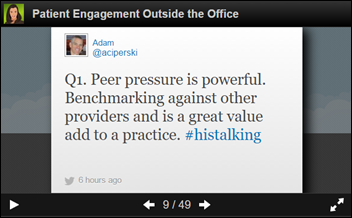
Join @JennHIStalk and @iatricFJF (Frank Fortner, president of Iatric Systems) for a discussion on portals, mobile devices and patient engagement. Preview #HIStalking discussion questions below and brush up on how to participate in a tweet chat towards the end of this post.

The healthcare industry – patients, providers, and vendors alike – have discussed patient-centered healthcare for a while. Today’s patient engagement isn’t the end-game because data from various, disparate systems sit in silos and isn’t easily accessed by patients. Further, most of today’s tools deliver a monologue of data flow “to” the patient, with very few solutions able to receive data “from” the patient. Providers must find better ways to deliver the tools patients need to truly become active in their own healthcare, where patient data from all sources is presented to patients in a simple, clear, and actionable way; and where appropriate patient-generated data has a pathway back to providers.
A recent run-in with my two year-old Lab mix named George and a sidewalk sent me to the local ED with a separated shoulder. The ED and orthopedist’s office separately emailed me instructions on how to enroll in their patient portals, and yet, like many patients, I did nothing with them.
I quickly realized the issue may not be that providers aren’t trying to engage patients or that there’s even a lack of technology; it might be that we aren’t using the technology already sitting in our hands.
Pew Research Center recently found that 64 percent of Americans own smartphones, with a large majority being used for Internet access. Combine this with the abundance of customized smartphones apps and it seems these handheld devices can be used for just about anything. The question then becomes, why aren’t these devices more prevalent in healthcare as a bridge across the patient engagement chasm?
As the president of a healthcare technology company that has created various patient portals, I completely see their value. But, combining portals with today’s smartphone technology – the device most have integrated into their every waking hour – would better enable patients to view, download, and transmit their health data from, and even back to providers. This would lay the groundwork for creating a more patient-centric and patient-involved environment.
During my time in the ED, if I could have enrolled my mobile device, which I would’ve done to take my mind off the pain, I would now have my imaging report, diagnosis, and electronic discharge instructions in my pocket and available for the next provider.
With that, I’m excited for the opportunity to host this Thursday’s #HIStalking tweet chat about patient portals, mobile devices, and how they can help engage patients.
#HIStalking Discussion Questions
Q1: How have you personally benefited from a patient portal or mobile patient access application?
Q2: Would consumerism have eventually drawn focus to patient engagement without the government’s push?
Q3: Patient portal adoption rates are near 25 percent, or one in four patients in physician practices of all sizes. Why isn’t this higher?
Q4: What killer app or feature is missing in today’s patient engagement solutions?
Q5: Technology has been the initial focus, but patient engagement is so much more. What has the industry missed by concentrating on portals?
Bonus Q: Looking down the road, in the next five-plus years, how do you feel today’s patient engagement initiatives will impact the healthcare experience?
Tweet Chat Instructions
It’s easy to join the Twitter conversation by logging into TweetChat, which automatically keeps you in the conversation by tagging all tweets with the #HIStalking hash tag. If you are unable to access the TweetChat room, simply search in Twitter for #HIStalking and follow the conversation. To contribute, be sure and tag your tweets with #HIStalking so they can be seen by other chat participants.
Contacts
Jennifer, Mr. H, Lorre, Dr. Jayne, Dr. Gregg, Lt. Dan
More news: HIStalk, HIStalk Connect.
Get HIStalk Practice updates.
Contact us online.
Become a sponsor.
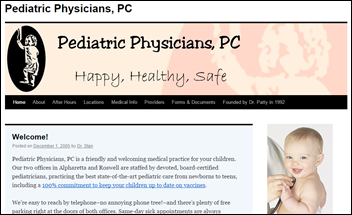
The article about Pediatric Associates in CA has a nugget with a potentially outsized impact: the implication that VFC vaccines…